

Stephanie
Stephanie
Boccuzzi
Boccuzzi
Today is the Solemnity of the Ascension and we shout with joy as we say, “AMEN! I believe in the Glory of the Risen One!”
“Amen” is an affirmation of faith, a personal and communal affirmation, and, at times, a quiet, intimateprayer. There is such power in this one word. A loud and vibrant “Amen” can stir the senses and uplift a congregation. It can also be a soft word, a way to cry out to God when we are lost for all other words.
As an educator the past three years, I have struggled to remain hopeful in light of COVID-19 and the racial injustices that permeate our world. My colleagues and I struggle to put forth enough energy to finish the end of the year with the same passion and excitement we normally would. We see the effects of COVID in our students' behavior and many times find ourselves at a loss for how to best serve their needs. We continue to wade in uncharted waters even though things are seemingly “back to the way they were before COVID.” But, as I have reflected on that sentiment - the “going backness” to the way things were before COVID - I fear weare setting ourselves up for a mindset of regression. We are being sucked into a backward facing future, rather than a forward facing one. We face the temptation to default to “what was” rather than “what needs tobe today.” With this mindset, I have felt a descending, rather than ascending to our present realities.
Similarly, the tragic shooting in Buffalo, New York reveals to us how racism and white supremacy still existin the United States. The misinformation of “Replacement theory” instills a hatred for the future and a longing for a world in which the black and brown community is controlled by a powerful white majority. This theory strikes at the very heart of me and my family. It argues that my husband, who is mixed race, and I should not have a biological child. It states that my niece and nephew, who are half Ugandan and half Italian, are a danger and a threat to society.
But, amidst this, as we focus on today’s Gospel we find our hope: Jesus said to his disciples:
“Thus it is written that the Christ would suffer
and rise from the dead on the third day
and that repentance, for the forgiveness of sins,
would be preached in his name to all the nations…”
This is why Jesus’ resurrection is so restorative. The resurrection could not happen without the horror of death. I realize what I share is heavy, but we can give praise and thanksgiving that we are in the Easter season - the most joyful season in our liturgical calendar. We hold fast that we are Easter people and our hope remains in the glory of God, the joy revealed to us through the life of Jesus, and the justice unlocked forus for all eternity.
Even more so, this Solemnity of the Ascension is the ultimate “here and now” moment that is the pinnacle of our faith. In light of our present realities, I see the Ascension as the means to which all wounds are healedand all hatred is transformed into new life in Christ. What was, what is, and what will be all converge in the Ascension and we are invited into participation in God’s glory.
Consider the disciples at this moment of the Ascension, too. They know Jesus will come again, but they do not know when. They can’t go back to the “way things were before Jesus” or try to “keep things exactly the same when Jesus was here.” This approach would not fulfill the Gospel. The powerful experience of Christ will remain only a historical event that inspired the people of the time and not demand anything of us today if that is the case.
St. Paul had an experience of the Risen Lord that changed the course of his life. He experienced a conversion - a total reorientation of his life - and his response to his encounter with Christ was “Amen.”
St. Mary Magdalene, who I stand in front of here, is the first at the tomb. While she is tempted to mourn what she has lost, she recognizes her teacher, proclaims “Amen” and shares this experience with hercommunity. I want to take a moment to lift up and bring awareness to the work of art behind me. This is “St. Mary of Magdala Proclaims the Resurrection,” crafted by Sr. Margaret “Peggie” Beaudette. When I first saw this sculpture it struck me profoundly. We see Mary raised, standing tall with her hand up, heralding the Good News that Jesus has resurrected. She ascends to what the moment demands; her entire self bears witness to the Resurrection and anticipates the Ascension.
This Solemnity asks us to Rise! Get up! Be empowered to be a light to the world!
And, to do so, we ask ourselves, “What does ascending mean after these past two years of global, national, and individual suffering?” “How can we rise up to meet the challenges of today?” “Do we situate our gaze on afuture of joy and restoration, or do we live in the pain and worry of the past?”
Ascending to the demands of today is hard work because it is unknown. We have to be vulnerable and admit that we are broken. Ascending is not rising above, it is rising with. Rising with the memory of pain and death,the memory of betrayal and sadness, but also with the glory and the hope that comes in the morning.
I pray that my students ascend! That they rise! Get up! And grow out of their fears so that they embrace theircapacities to fully engage with the world again. I pray that the communities who continue to face systematicracism and hate continue to be resilient and faithful in suffering.
On this Solemnity we celebrate that Jesus is lifted, raised up, exalted and glorified. And, so will we! Amen! Amen! Amen!
Stephanie Boccuzzi
Stephanie Boccuzzi

Stephanie Boccuzzi is a former theology teacher, writer, speaker, and the Board President of the Women's Ordination Conference, working to advance the full participation of women in the life and leadership of the Catholic Church. She holds a Master of Divinity from the Jesuit School of Theology of Santa Clara University and has worked with a range of nonprofit organizations both in the United States and abroad. In her last role, she served as Mission Leader for Trinity Health of New England. In recent years, she has become an advocate for the chronic illness and disability community, drawing from her own experience living with Myasthenia Gravis and ME/CFS. A continued area of focus and passion is reimagining the workplace as an adaptive environment that meets the needs of all people — whether through coaching, formative exercises, retreat experiences, building or strengthening employee resources, or challenging existing organizational systems. She lives in Bucks County, Pennsylvania, where you can find her exploring with her nieces and nephews, watching a lot of tennis, dabbling in watercolor painting, and enjoying small-town life.
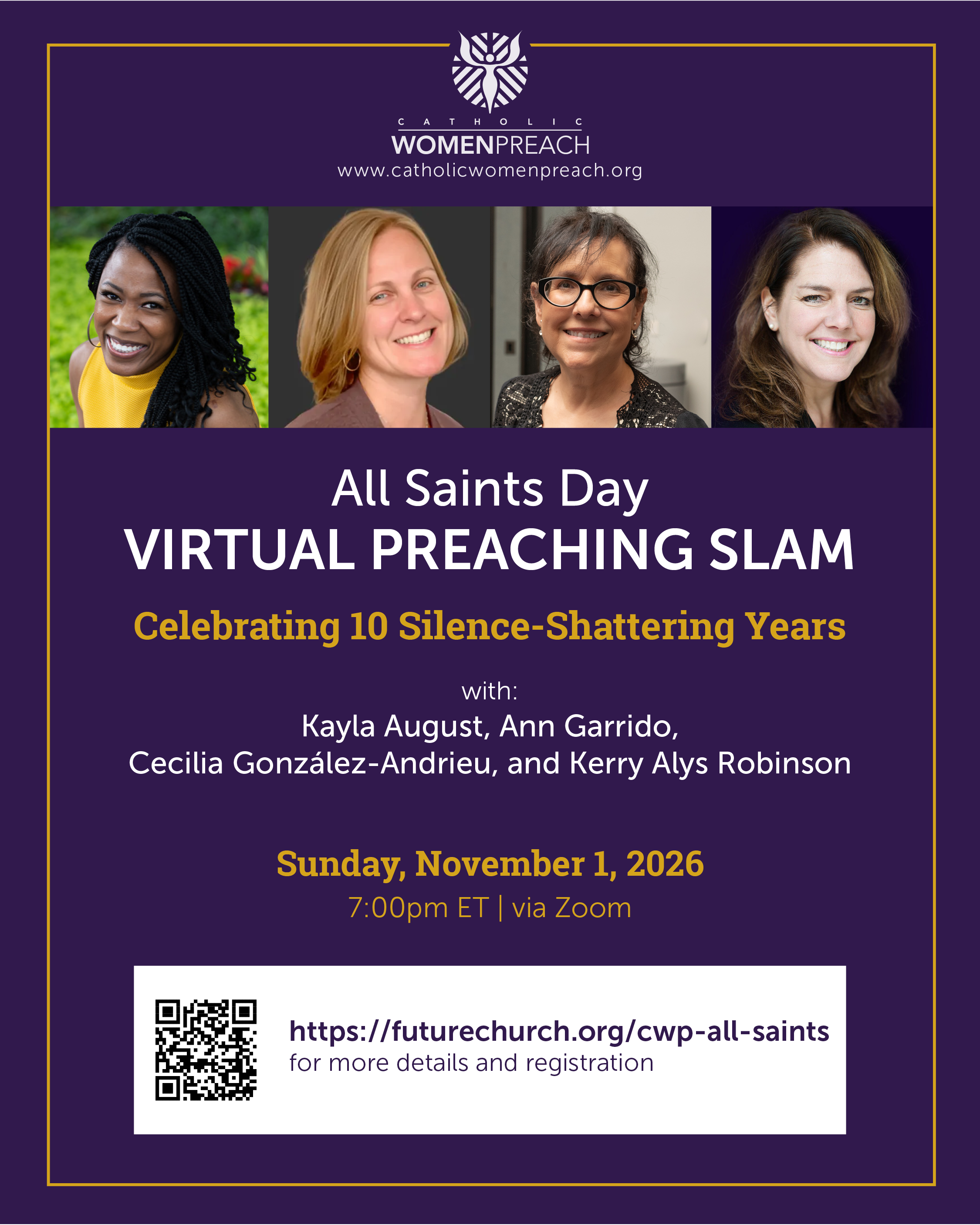
Sunday, November 1 at 7pm ET on Zoom: Join Catholic Women Preach, FutureChurch, and four extraordinary preachers as we celebrate the 10th Anniversary of Catholic Women Preach the best way we know how - by preaching!
We'll gather for a beautiful Liturgy of the Word with Kayla August, Ann Garrido, Cecilia González-Andrieu, and Kerry Alys Robinson who will break open the texts and uplift a woman saint of their choosing.
Ten years of raising voices and renewing the Church. Ten years of preaching that widens the table. Ten years of shattering the silence. Come celebrate with us!
Advertise with Catholic Women Preach: email Russ at russ@futurechurch.org
