

Rhonda
Rhonda
Miska
Miska
“Turn the other cheek?” When taken at face value, today’s Gospel seems to present Jesus telling us to be doormats, to simply and passively accept mistreatment. But this doesn’t square with the Jesus we know: he challenges hypocrisy and isn’t afraid to question abuses of power, sometimes sharply. And over and over Jesus shows compassion to the sick, the poor, the suffering. So what do we do with Jesus’ three examples?
Well, context is everything! Let’s dig more deeply into what Jesus’ original listeners would have known that we, with our 21stcentury, Western lens, don’t know about these three examples.
First - turn the other cheek. In that culture, as in many Middle Eastern cultures today, the left hand is considered unclean. In this imagined scenario, the person striking uses his right hand. Now, within the hierarchies of the time, a superior would strike an inferior – say, a master and a slave - with a backhanded strike. So if you are struck, by turning and offering your other cheek and almost daring them to strike you straight on, the oppressor faces a dilemma. If he strikes you straight on, not with a backhand, then he is hitting you the way that culturally one hits their equal. All of a sudden, the tables are turned. In the words of theologian Walter Wink, to turn the other cheek is to say, "Try again. Your first blow failed to achieve its intended effect. I deny you the power to humiliate me. I am a human being just like you. Your status does not alter that fact. You cannot demean me."
“Turn the other cheek,” then, in the context of those who first heard these words in Roman-occupied Galilee 2000 years ago, isn’t about passivity, but responding to violence and injustice with resistance, courage and God-given human dignity.
Secondly, “from the person who takes your cloak, do not withhold even your tunic.” Remember those hearing Jesus’ message lived under Roman occupation and heavy taxation. In the scenario, the one demanding your cloak would have been probably seeking payment of a debt, one caused by the heavy burden of Empire. Scholars explain that a poor person would have really only have a cloak and a tunic – to give up both of these things is to essentially strip naked! Now, unlike our culture, in that culture at the time the shame was experienced by person who saw the other naked. So if you give up your cloak and tunic, standing naked, you escalate the situation, creating a drama that exposes the injustice. You stand naked before your oppressor, a powerful critique of his unjust action. All of a sudden, the tables are turned. It isn’t about passivity at all, but responding to violence and injustice with resistance, courage, and God-given human dignity.
Finally, walk the extra mile. Again, context is everything. Roman soldiers could, under law, could require those who they occupied, to carry their heavy pack for one mile. But if you insist on carrying the bag a second mile – you’d be requiring the soldier to break the law! All of a sudden, the tables are turned. Now you’re the one with more power. It isn’t about passivity at all, but responding to violence and injustice with resistance, courage, and God-given human dignity.
In each of Jesus’ examples, the enemy is neutralized, not destroyed. The cycle of violence is broken, the violence of the oppressor is exposed. The God-given human dignity of a marginalized person is uplifted. The system that strikes people, takes their few belongings, and compels them to carry a heavy load is critiqued.
Today’s Gospel is not about passively accepting injustice – that’s not Good News. Today’s Gospel is not about simply shrugging our shoulders when we witness or are victimized. This Gospel challenges each of us, as it challenged the original listeners, to creative nonviolent resistance to injustice.
So having explored the context of each of these examples and what they meant two millennia ago, we have to ask, what does this Gospel mean for you and for me today, in 2019, in our world?
As I prayed with each of these examples, I thought of some of young people I am blessed to accompany in Dominican University Ministry, some of whom are not documented, and have faced or still face discrimination, xenophobia, bullying, and marginalization because of documentation status. A few weeks ago, at an interfaith storytelling event, one of our undocumented students – I’ll call her Isabel – shared her story of responding to injustice with resistance, courage, and God-given human dignity. And Isabel gave me here blessing in sharing her story with you.
She challenged an authority figure who supported the policy of separating children and their parents at the US-Mexico border. Isabel described how she worked not to become angry, but to stand up for herself, for other immigrants, and to speak the truth. The situation escalated as this authority figure told Isabel she wasn’t behaving as she should, but Isabel stood her ground, affirming her own and all of our human dignity. I recall the words of our Dominican sister Catherine of Siena – “speak the truth in a thousand voices, it is silence that kills.”
Young people like Isabel who courageously announce that they are undocumented and unafraid are taking a risk not unlike the creative, subversive risks advised by Jesus in today’s Gospel. In claiming their dignity, they name the injustice of a broken system that labels them and their families criminals. In refusing to hide in the shadows and be intimidated, in rejecting the label of alien, in affirming family unity, affirming the dignity of their dreams, the truth that they are beautiful, beloved children of God, they turn the other cheek.
2000 years ago in Roman-occupied Palestine, Jesus called for his followers to act with love, in joyful resistance, in creative nonviolence. Today, Jesus offers the same beautiful, demanding, life-affirming call to all of us as the People of God. Today, how will we respond to Jesus’ challenge?
Rhonda Miska
Rhonda Miska
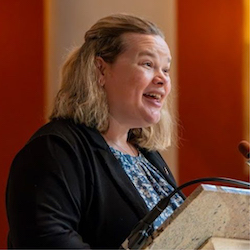
Rhonda Miska is a preacher, teacher, spiritual director, writer, and lay ecclesial minister. She serves as Communication Director at the Church of St. Timothy and is a member of St. Thomas More Catholic Community in the Archdiocese of St. Paul/Minneapolis. Rhonda is the founder and co-convener of the Catholic Women’s Preaching Circle, a peer community of Catholic women supporting and accompanying one another in breaking open God’s Word. She serves as the Lead Cohort Facilitator of PROCLAIM, a 22-month formation program for Catholic women in preaching and ministry of the Word.
Rhonda holds an MA from the Boston College School of Theology and Ministry and a certificate in spiritual direction. She is currently pursuing a Doctorate of Ministry in Preaching from the Aquinas Institute of Theology. She has served in parishes, universities, retreat centers, and as a Jesuit Volunteer (Nicaragua, 2002-2004). Her passion for preaching led her to discern vowed life with the Order of Preachers and she was in formation with Dominican Sisters from 2016-2020. Rhonda has served on the advisory board of Catholic Women Preach since its inception. She is active with Discerning Deacons, a movement to engage Catholics in discernment around the restoration of the diaconate to women.
Her writing has appeared in Catholic Women Speak: Bringing Our Gifts to the Table (Paulist Press, 2016), Pope Francis Lexicon (Collegeville, 2018), Catholic Women Preach: Raising Voices, Renewing the Church(2022), and Green Saints for a Green Generation (Orbis, 2024). She has also published in various print and online publications including America Magazine, U.S. Catholic, and Presence: A Journal of Catholic Poetry.

October 17 at 7pm ET: Join Catholic Women Preach, FutureChurch, contributors to the Year C book, and co-editors Elizabeth Donnelly and Russ Petrus as we celebrate the release of the third and final volume of this ground-breaking, award winning series.
"Catholic Women Preach is one of the more inspiring collection of homilies available today. Based on the deep spirituality and insights of the various women authors, the homilies are solidly based on the scriptures and offer refreshing and engaging insights for homilists and listeners. The feminine perspective has long been absent in the preached word, and its inclusion in this work offers a long overdue and pastorally necessary resource for the liturgical life of the Church." - Catholic Media Association
Advertise with Catholic Women Preach: email Russ at russ@futurechurch.org
