

Kelly
Kelly
Sankowski
Sankowski
We were on the way to the hospital for the birth of my second son when we decided what his middle name should be. We decided on Thomas. Given that we met at a church named after St. Thomas Aquinas on the campus of a university founded by Thomas Jefferson, many people probably assumed he was named after one of those men. But he was actually named after the Thomas in today’s gospel, because we believe he has gotten a bad rap.
He has been known through the ages as “doubting Thomas” because he did not believe the apostles’ story about the risen Jesus appearing to them. He demanded to see it with his own eyes.
This has always seemed unfair to me, because he was only asking for what other people – the other apostles – already got. We have made this one moment of doubt his defining characteristic, and I don’t think any of us would like it if this is what happened in our own lives.
So, on this Divine Mercy Sunday, I would like to invite us to consider Thomas through God’s merciful eyes. For when we look at the whole context of his life, we see that it is not doubt that defines him, but rather courage, critical thinking, and a willingness to stand out from the crowd.
Earlier in the gospel of John, we see that Thomas plays an important role in another story – the raising of Lazarus. Jesus and his disciples had left Jerusalem because people had started to threaten to kill Jesus for saying he was the son of God. Then, they receive the message from Mary and Martha telling Jesus that their brother, Lazarus, was ill. When Jesus tells his disciples that he intends to go back to Judea, they challenge him, saying, “Rabbi, the Jews were just trying to stone you, and you want to go back there?” (John 11:8). Thomas is once again a lone voice – this time, urging the others to follow Jesus. He tells them, “Let us also go to die with him” (John 11:16).
In John chapter 14, Jesus tells his disciples that he is going to prepare a place for them in his Father’s house, and that they know the way. Thomas, clearly thinking critically about this, asks, “Master, we do not know where you are going; how can we know the way?” (John 14:5).
And finally, the beginning of today’s Gospel passage tells us that Thomas was not with the other apostles when Jesus first appeared to them. Why not? We don’t know, but I wonder if it is because while the others were hiding behind locked doors out of fear, Thomas was once again courageous enough to still be out in the world, continuing the work of Jesus, even if it meant risking his own death.
The same characteristics that led Thomas to need to see the resurrected Jesus with his own eyes are the ones that gave him the strength to follow Jesus at a great risk, and to ask important questions to gain a deeper understanding of Jesus’s message.
When Jesus looks at Thomas in the second half of today’s Gospel, he doesn’t just see “the doubter”. He sees the whole person – the man whose courage and critical thinking have given him the strength to be one of his most ardent followers, but have also made it hard for him to believe in this improbable miracle. Jesus sees it all, and has mercy on Thomas. While he does point out where Thomas could have done better, saying, “Blessed are those who have not seen and have believed,” Jesus also gives Thomas exactly what he needs: he lets Thomas touch his wounds.
This is also true when God looks at you. God sees the whole picture of your life - not just the weaker moments that others might define you by. God does not just see your impatience with your children, or the way you never can seem to remember to bring reusable grocery bags to the story. God does not just see the ways you fall short, the things that you are afraid of, or the long list of things in your head that you think you are doing wrong. God sees those things, sure, but God also sees the care that you have for your loved ones, God sees the way that you work for justice, even if it is imperfect, God sees the ways you have grown, and the ways you are still trying to do better. And God sees how all of that has brought you to this moment. In God’s infinite mercy, no one moment can ever break God’s love.
It strikes me that Thomas might be exactly the saint we need at this moment. The news cycle of this Lenten season was one of violence and war. When so many of us are either tempted toward greed and power or tempted toward despair at the state of the world, we need someone who is thinking differently. Someone who is courageous enough to challenge the status quo. Someone who doesn’t remain inside the locked doors of paralysis when problems seem too large, but is willing to continue doing the important work of building God’s Kingdom.
As we enter into this joyous Easter season, may the mercy and love of God empower us to be more like Thomas: to use the brain that God gave us to ask difficult questions, and to be courageous in our following of Jesus.
Kelly Sankowski
Kelly Sankowski
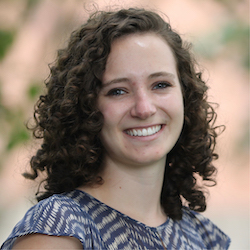
Kelly Sankowski is a writer, lay minister, and mother of two young boys. She holds a B.A. in English and Religious Studies from the University of Virginia and a M.A. in Theology and Ministry from Boston College. A native of the Washington, D.C. suburbs, she began her career as a reporter for the Catholic Standard newspaper of the Archdiocese of Washington, where she had the opportunity to cover everything from Catholic school inclusion programs to national politics to World Youth Day in Panama City. In recent years, Kelly has focused her work on women in the Church, contributing to reporting on diocesan maternity leave policies, pregnant and parenting students on Catholic college campuses, and Catholic women who are teaching priests homiletics. Her writing has earned several Catholic Media Awards. Kelly also served as the Editorial Assistant for the Catholic Women Preach book series and writes a monthly Substack, The Moon’s Shadow. This Easter season, she will be beginning a new role as the campus minister for Cardinal Stritch Catholic High School & Academy in Oregon, Ohio. She lives in Toledo, Ohio with her family, where she also serves on the pastoral council for St. Martin de Porres Catholic Church.

October 17 at 7pm ET: Join Catholic Women Preach, FutureChurch, contributors to the Year C book, and co-editors Elizabeth Donnelly and Russ Petrus as we celebrate the release of the third and final volume of this ground-breaking, award winning series.
"Catholic Women Preach is one of the more inspiring collection of homilies available today. Based on the deep spirituality and insights of the various women authors, the homilies are solidly based on the scriptures and offer refreshing and engaging insights for homilists and listeners. The feminine perspective has long been absent in the preached word, and its inclusion in this work offers a long overdue and pastorally necessary resource for the liturgical life of the Church." - Catholic Media Association
Advertise with Catholic Women Preach: email Russ at russ@futurechurch.org
