

Claire
Claire
Lucas
Lucas
Today's first reading takes us to a pivotal moment of conflict in the early Church — one whose resolution gave rise to an entirely new form of ministry: the diaconate. The apostles created this new ministry out of a specific need. The Greek-speaking widows in the community of Jesus followers were being neglected in the communal pastoral care.
So the Apostles asked the community to choose leaders from among themselves who could help prevent such situations in the future. People were falling through the cracks.
Sound familiar? It happens in every community, every generation. But here, the early Church did something different — something diaconal. They organized. They appointed. They made sure no one was forgotten. Neglect of the most vulnerable would not be the way for the followers of Jesus—and it was deacons who carried the responsibility for making it so.
In the Gospel for today, Jesus says to Thomas: “I am the way, the truth and the life. No one comes to the Father except through me.”
Because of their encounter with the living Christ, with Jesus who is the way, the truth and the life, the Apostles knew that letting those amongst them fall through the cracks was not the way of Jesus. There needed to be a ministry, a specific group of wise and Spirit-filled people, who would ensure that no one, especially the vulnerable, was forgotten.
At the heart of today's readings are two connected movements: the transformation that comes from encountering the living Christ, and the diaconal response that flows from it -- a ministry that trains our eyes on our deepest vulnerabilities, within ourselves and within the communities we serve.
In a season in which we seek to intentionally embody the living Christ in our lives, we look around our broken world where suffering still abounds. Even as an Easter people, we have not forgotten Good Friday. How do we embrace our own baptismal call to diakonia, to be Christ the Servant, as the apostles did, to ensure that no one falls through the cracks? And why does this matter now?
Something many people don’t know is that the modern permanent diaconate has some of its early roots in a Nazi concentration camp. Over 2,000 Catholic priests were incarcerated together at Dachau. For many of these priests, a vital step toward building up the body of Christ was restoring the diaconate as a permanent vocation for married men—a practice that had been dormant for the previous millennium when the diaconate was solely a step on the road to the priesthood. The witness of these priest-survivors of Dachau would be consequential for the decision of bishops at the Second Vatican Council to renew the diaconate as a permanent ministry.
The Body of Christ needed a visible sign not just of Christ the Priest or Christ the King but also of Christ the Servant in a world plagued by profound suffering. For these priests—beaten, tortured, put to work building Dachau’s ovens—the permanent diaconate was one way the Church could structurally work to ensure that the horrors of the Second World War would never be repeated.
Our Scripture readings today, together with the story of the priests imprisoned at at Dachau, show us a diaconate that was created by the early church as a response to the needs of the People of God, to embody the living Christ in the world, and to animate the servant leadership of all the baptized. Throughout the centuries that followed, the Church would build upon and adapt this ministry as the needs of the People of God changed.
The 2024 Final Document of the Synod on Synodality, which Pope Francis adopted as magisterial teaching, had some important things to say about the state of diaconal ministry in the Church today. In Paragraph 73, it affirmed the value of the diaconate in the growth of a Servant Church while acknowledging its uneven implementation around the world since its restoration at Vatican II. It also called for further study of the "lived experience of the diaconate." Paragraph 60 of the document Final Document affirmed that, "the question of women’s access to diaconal ministry remains open. This discernment needs to continue."
A question before us now is, what kind of diaconate do the People of God need today? How is the Holy Spirit inviting the Church to exercise its authority to renew and adapt this ancient ministry in response to the signs of these times? And would including women as deacons enhance our capacity to embody Christ the Servant in a world desperate for that witness?
Living as a diaconal people, an Easter people, deeply changed by our encounter with Christ who is the way, the truth and the life, means that, even as we discern, we must act.
In our Gospel Jesus says, “Whoever believes in me will do the works that I do, and will do greater ones than these, because I am going to the Father.”
We are called to act now with boldness–to look amongst us and say–where can we be deacon to those in need? Who are the Greek-speaking widows being neglected in our midst, in our day, in our generation? Who is most vulnerable; who is the other? Who is most at risk of falling, or being pushed, through the cracks, and how are we, as the Body of Christ in the Church, changed by our encounter with the Living God, called to respond?
Claire Lucas
Claire Lucas
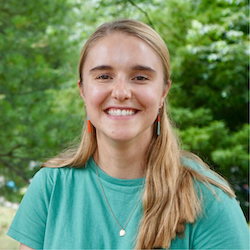
Claire Lucas is the Program Associate for Formation and Engagement at Discerning Deacons, an organization whose mission is to engage Catholics in the active discernment of our Church about women and the diaconate and contribute to the renewal of this ministry for our times. In this role, Claire also supports the work of PROCLAIM, a formation program for Catholic women to grow their skills to preach and proclaim God’s Word. Originally from Oregon, Claire lives in rural southeastern Montana where she first moved as a Jesuit Volunteer/Americorps member with Jesuit Volunteer Corps Northwest. Since living in Montana, Claire has worked in multiple positions at an assisted living facility for Northern Cheyenne elders, as well as in hospital chaplaincy in Billings, Montana.
Claire earned her Bachelor of Arts in Psychology and Theology and Religious Studies from Seattle University in 2019. She is in the process of earning her Master of Arts in Theology and Ministry from Boston College Clough School of Theology and Ministry, and looks forward to graduating in December 2026. Claire’s professional experiences throughout her career in social justice education, end-of-life care, writing and storytelling, administrative support and hospital chaplaincy have all inspired her to hone her skills to pursue a life of service and ministry for the people of God. Claire embraces a spirit of authenticity and meaning-making that informs her work, always curious about the most challenging and beautiful experiences in people’s lives (and everything in-between). In her free time, Claire loves being outside as much as possible, walking, swimming, gardening, crocheting and traveling around the country to see family and friends.

October 17 at 7pm ET: Join Catholic Women Preach, FutureChurch, contributors to the Year C book, and co-editors Elizabeth Donnelly and Russ Petrus as we celebrate the release of the third and final volume of this ground-breaking, award winning series.
"Catholic Women Preach is one of the more inspiring collection of homilies available today. Based on the deep spirituality and insights of the various women authors, the homilies are solidly based on the scriptures and offer refreshing and engaging insights for homilists and listeners. The feminine perspective has long been absent in the preached word, and its inclusion in this work offers a long overdue and pastorally necessary resource for the liturgical life of the Church." - Catholic Media Association
Advertise with Catholic Women Preach: email Russ at russ@futurechurch.org
