

Ashley
Ashley
Kitisya
Kitisya
I reflect on what it means to live responsibly in a world where the consequences of our actions are increasingly evident. Across the globe, communities are facing devastating floods, prolonged droughts, destructive wildfires, and rising seas. These are not merely environmental events. They raise questions of justice: who is most exposed to danger, who has the resources to recover, whose voices are heard, and whose suffering is too easily overlooked.
The readings today speak to this reality.
In the First Reading, God tells Ezekiel: “I have appointed you watchman for the house of Israel.” Ezekiel is given a difficult responsibility. He is not merely asked to observe what is happening around him. He is asked to speak, to warn, and to call people back from destructive ways. The role of the watchman is not glamorous. It may involve discomfort, misunderstanding, or rejection. But God tells Ezekiel that silence has consequences.
This reading makes me ask: what does it mean to be a watchman today?
Perhaps it means paying attention when we would rather look away. It means refusing to treat others’ suffering as distant or inevitable. It means recognising that they are also signs of deeper inequalities: of decisions made without regard for the poor, of economic systems that put profit before people, and of a failure to care for creation as a shared gift.
The First Reading reminds me that knowledge entails responsibility. When we know that people are suffering and understand that our choices may contribute to harm, we cannot pretend we have no role to play. To be a watchman is not to condemn others from a distance. It is to speak the truth with humility, to act with courage, and to remain faithful even when the message is difficult to hear.
Ezekiel’s call challenges us to use any education, skill, or professional position not merely for personal success, but to speak when silence would allow harm to continue.
The Second Reading from Saint Paul’s Letter to the Romans provides the foundation for this responsibility: “Owe nothing to anyone, except to love one another.” Paul tells us that all the commandments are fulfilled in this one instruction: “You shall love your neighbour as yourself.” He then makes the meaning unmistakably practical: “Love does no evil to the neighbour.”
This is a simple sentence, but it is not an easy one. Love is not merely a private feeling or a good intention. Love must shape how we act, the choices we make, and the systems we support. If love does no evil to the neighbour, we must ask whether our way of life causes harm to people near or far.
The Second Reading expands the meaning of neighbour. My neighbour is not only the person beside me. My neighbour is the family living near a polluted river. My neighbour is the farmer whose crops have failed because the rains no longer follow familiar patterns. My neighbour is a community forced to move because a wildfire, flood, or rising sea has made their home unsafe. My neighbour is also the child who will inherit the consequences of choices made long before they had any voice in them.
To pursue justice faithfully means listening carefully to the vulnerable. It means taking seriously the testimony of people who may lack power, wealth, or influence.
The Gospel presents a further challenge. Jesus addresses what we should do when harm occurs within the community. He does not tell us to ignore wrongdoing, gossip about it, or withdraw from one another. Instead, he calls for honest conversation, accountability, and reconciliation. If one person does not listen, others are brought into the process. If the matter remains unresolved, the wider community is involved.
This Gospel teaches that responsibility is not only individual but also communal. We belong to one another. When a person is harmed, a community is neglected, or creation is damaged, the whole community has a responsibility to respond. The Gospel challenges us not to turn away from difficult conversations about injustice, climate change, inequality, or the misuse of power. It calls us to face these realities together and truthfully.
The Gospel challenges us to ask whether we are willing to stand with those most affected. Are we willing to bring their concerns into the public sphere? Are we willing to question policies, investments, and habits that shift the burden of environmental destruction onto those with the least power? Are we willing to seek not only personal innocence but also collective healing?
Jesus then offers a promise: “Where two or three are gathered together in my name, there am I in the midst of them.” This is a word of hope, reminding us that we are not asked to bear the world’s weight alone. Christ is present when people gather in truth, prayer, solidarity, and action.
Christ is present when neighbours organise to help families after floods. Christ is present when communities protect forests and water sources. Christ is present when young people speak courageously about the world they will inherit. Christ is present when we use their diverse gifts to defend the vulnerable and serve the common good.
Amen.
Ashley Kitisya
Ashley Kitisya
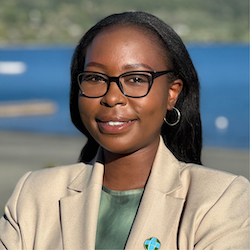
Currently serving as Director of Africa at the Laudato Si’ Movement, Ashley spearheads continental initiatives that unite faith-based communities, youth, activists, and policy influencers to champion fossil fuel divestment and sustainable energy transitions. Her leadership in cultivating strategic alliances has substantially elevated climate awareness and grassroots activism among diverse communities and institutions.
Ashley’s academic background in Law (LLM Strathmore University, LLB Catholic University of Eastern Africa), complemented by advanced training in justice, peace, and environmental governance, underpins her rigorous approach to policy advocacy and campaign development. She has contributed influential policy positions to climate negotiations, such as COPs, and the Africa Climate Summit. She actively engages in programs with the UN Environment Programme and other multilateral initiatives. Ashley is based in Nairobi, Kenya.
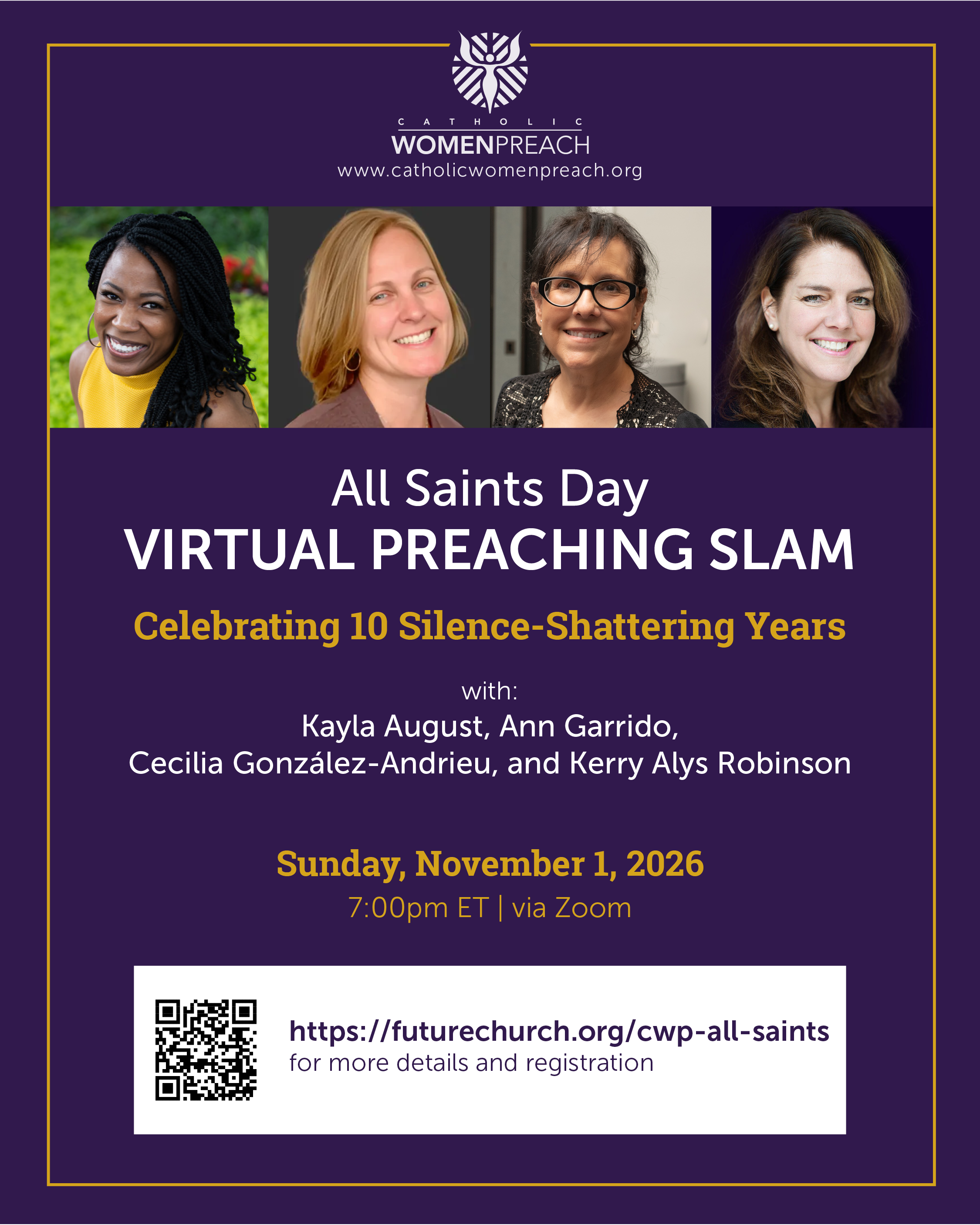
Sunday, November 1 at 7pm ET on Zoom: Join Catholic Women Preach, FutureChurch, and four extraordinary preachers as we celebrate the 10th Anniversary of Catholic Women Preach the best way we know how - by preaching!
We'll gather for a beautiful Liturgy of the Word with Kayla August, Ann Garrido, Cecilia González-Andrieu, and Kerry Alys Robinson who will break open the texts and uplift a woman saint of their choosing.
Ten years of raising voices and renewing the Church. Ten years of preaching that widens the table. Ten years of shattering the silence. Come celebrate with us!
Advertise with Catholic Women Preach: email Russ at russ@futurechurch.org
