

Nóirin
Nóirin
Lynch
Lynch
Anthony De Mello tells a story about a small farmer who realised he had a field that he wasn’t using or minding well. So, after some thought, he put up a sign in the field that read ‘this field will be given to the one who is completely satisfied’. People stopped as they passed, excited about the opportunity. Then they would shake their heads and realise they weren’t satisfied and so couldn’t have it.
Eventually the richest person in the area drove up to the door of the small farmer, in a car worth more than the annual income of most. Stepping out he declared, I am the richest man in this area. I own everything with no debt and have a house paid for, for every child of mine. I am retired and enjoying the spoils of my hard work with family. On reflection is it clear to me that I am completely satisfied, and so I have come to claim this field which I can and will use well’.
The small farmer looked at him with soft eyes and said, ‘Ah, my friend, you have done very well, better than most of us. Permit me to ask though: if you are completely satisfied – why do you want the field?’
You and I are good people who trust in God for the most part. We trust in God for daily life, for our pension and retirement and for whatever comes after that – don’t we? We trust in God to treat us justly and to mind us well so that we can rest in the Lord’s love – don’t we?
So why is it that when we see others do well, some little niggle moves through some of us and we find ourselves wondering why ‘they’ are doing well, compared to us (who perhaps we thought might do better). Oh, we berate ourselves for even thinking it, but it arises.
We see it in family – I don’t want to be jealous of how well my siblings or cousins are doing, but it niggles.
We see it in communities – I want others to be treated well, but I deserve those tax breaks first, just as a matter of fairness and then I will volunteer/donate.
We see it in borders – I love everyone, once they’re legal cause I did it right, so why shouldn’t they? (did you, did you really? lol)
We see it internationally – you can’t expect us to prop up other countries, in health care, disease control, climate emergencies - even when it’s clear all we have here is based on how we plundered (still plunder?) other countries. But that wasn’t us personally, so we shouldn’t suffer for that?!?
We are nice people, we deserve nice things. We donate, we tithe, we are kind. We are satisfied with our lot. Until we see what others have, perhaps? We trust God and we really want to be satisfied that God will bless us always.
So why the niggle? Why the need to keep an eye on what the neighbour is getting?
Now before we beat ourselves up, let’s be prayerful and kind about this. This is a wound in us. It’s not just plain greed, it’s often really fear, isn’t it.
For most of us, we began life utterly confident of love. Somehow, somewhere, we got hurt. Wounded. And now we believe – somewhere deep inside - that if we share, we will get hurt again. So, we keep an eye on what the neighbour/sibling/country is getting and we wonder what that says about our value, our worth, about whether we are really loved and loveable or not.
We are not completely satisfied, and that’s the way many of us enter into the second or final part of life. The part that’s all about letting go and surrendering into the love of God who will mind you.
So, today's gospel is written specifically about many of us and for many of us. The ones who are doing ok but are nervous of others doing well.
The nice thing is that Jesus recognised this quality in many, so we’re not uniquely sinful. We’re human!!
This week’s readings call us to three things
- To seek out God honestly, bringing ourselves just as we are, to be loved
- To trust that God is not a relationship to be earned, but that God is already near to all who seek God – so God is with you, and not some future earning or not dependent on how much love God has left over after loving everyone equally!
- To let go of the comparison and the fear of being underpaid in comparison to others. The fear of being under loved, under appreciated
Mary Oliver wrote:
To live in this world
you must be able to do three things:
to love what is mortal;
to hold it against your bones
knowing your own life depends on it;
and, when the time comes to let it go, to let it go
The first letting go for us this week might be noticing and letting go of the fear that others are doing better than us. It really doesn’t matter, it’s just comparisons in a consumer/capitalist world. Let it go. Trust in God’s love. Bring the struggle with that to God in prayer.
The bigger letting go might be over the years ahead – noticing and letting go of the fear that God couldn’t possibly really love us totally, not if God knew us. Catching the places where we insist God must be mad at us, healing the fears of being unworthy. Until we reach a moment, a nirvana, where we accept that we are truly beloved, and can rest completely satisfied into the arms of God.
Sounds like Heaven, doesn’t it! Heaven on earth.
Nóirin Lynch
Nóirin Lynch
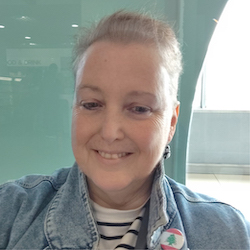
Nóirin Lynch lives in Co Clare in Ireland where she is Director of the FCJ Spirituality House in Spanish Point, an Ignatian retreat centre, one field off the Atlantic.
Nóirin was born in Limerick city and has been involved in pastoral ministry since 1992. Youth ministry, school chaplaincy, and service as a parish pastoral work for the English-speaking community in Munich, Germany, filled her early years until she returned to Ireland in 2001 to work in Kerry, Limerick and Cork & Ross dioceses as support for parishes and parish teams. For the last 8 years Nóirin has worked with religious sisters in Dublin and Limerick as director of retreat centres, offering spaces apart for spiritual seekers.
In her spare time Nóirin is a singer-songwriter who has hosted singing circles across the island and created 2 CDs of Irish Folk music. She loves listening to, and learning from, those who carry songs and stories from small local communities, and she believes deeply that their wisdom is both healing and inspiring for us all.

Sunday, November 1 at 7pm ET on Zoom: Join Catholic Women Preach, FutureChurch, and four extraordinary preachers as we celebrate the 10th Anniversary of Catholic Women Preach the best way we know how - by preaching!
We'll gather for a beautiful Liturgy of the Word with Kayla August, Ann Garrido, Cecilia González-Andrieu, and Kerry Alys Robinson who will break open the texts and uplift a woman saint of their choosing.
Ten years of raising voices and renewing the Church. Ten years of preaching that widens the table. Ten years of shattering the silence. Come celebrate with us!
Advertise with Catholic Women Preach: email Russ at russ@futurechurch.org
