

Marilín
Marilín
Llanes, OP
Llanes, OP
A Call to Common Life for the Common Good
In a world where division can grow louder than compassion, where disagreement can harden into distance, and where fear can turn neighbors into strangers, the Letter to the Philippians offers us a timely and urgent invitation: to live in harmony with one another for the sake of the Gospel.
Paul’s question still reaches across nearly twenty centuries and speaks directly to us today: How shall we, as the People of God, live with one another? Can we seek common ground before discord becomes division? Can we become signs of communion in a fractured world?
Movement One: Paul’s Call to Gospel Partnership
Paul is not simply asking the Philippians to be polite, agreeable, or pleasant. He is calling them to something deeper: communion rooted in Christ, commitment to one another, and shared responsibility for the common good. Biblical scholars Luter and Lee describe this as a “mutual partnership in the Gospel.”
That partnership is not casual. It is not occasional. It is not reserved for moments when life is easy. Gospel partnership is the long, faithful work of caring for one another, praying for one another, encouraging one another, forgiving one another, and walking together because our bond in Christ is stronger than the forces that try to pull us apart.
Movement Two: The Long Road of Reconciliation
To become Gospel partners for the long haul means choosing a way of life that does not run from tension, pain, or difference. It means seeking forgiveness where wounds remain tender. It means choosing reconciliation when resentment would be easier. It means allowing faith in Jesus Christ to shape not only what we believe, but how we speak, how we listen, how we repair, and how we begin again.
To live the common life for the common good is to choose humility over rivalry, service over self-interest, mercy over judgment, and reconciliation over resentment. This is not weakness. This is the strength of Christ made visible in community.
Movement Three: Having the Mind of Christ
Paul encourages the Philippians, but he also writes to the community with pastoral courage. He names the need for reconciliation between Euodia (Uodia) and Syntyche (Sintigee) and calls them back to unity in God. Their disagreement mattered because the witness of the community mattered.
Then Paul gives the community a demanding measure of discipleship: “Do nothing out of selfishness or conceit, but in humility regard others as more important than yourselves. Let each of you look not only to your own interests, but also to the interests of others.”
And then Paul points to Christ. Christ is the pattern. Christ is the way. Christ is the measure of our common life: “Have in you the same attitude that is also in Christ Jesus, who, though he was in the form of God, did not regard equality with God something to be grasped.” If we want to know how to live in harmony together, we must look to Jesus, who emptied himself in love.
Movement Four: Dominican Common Life as Preaching
Paul’s vision of humility, reconciliation, and shared purpose also illuminates the Dominican tradition. For us in the Order of Preachers, founded by St. Dominic de Guzman, vita communis—common life—is not merely a practical arrangement. It is part of the preaching itself.
The way we live together proclaims the preaching. Our patience preaches. Our forgiveness preaches. Our willingness to remain at the table preaches. Our shared life becomes a living homily when it shows the world that unity does not require sameness, and love does not wait for perfect agreement.
Movement Five: Building the Beloved Community
So what does building the common good look like? In Magnifica Humanitas, Pope Leo writes that “the common good implies, first and foremost, building on a firm relationship with God.” He also reminds us that it means “accepting the limits and weaknesses of humanity without considering them an error to be corrected.” And he insists that the work belongs to all of us: “No one can single-handedly bear the weight of the challenges the world is facing, just as no one is so weak that they cannot play their part…” (pp. 18–19).
This is the beloved community: a people grounded in God, honest about human weakness, courageous before injustice, and committed to the flourishing of all. To build it, we need more than good intentions. We need practices of Gospel partnership like:
· Courage to get our hands dirty on the “construction sites” of our time and to denounce injustice.
· Willingness to sacrifice, even when discipleship carries a real cost.
· Empathy to feel the pain of others, especially those who are marginalized, persecuted, or detained.
· Readiness to enter difficult and awkward conversations with community, family, friends, and colleagues.
Jesus did not send one disciple alone. He gathered companions. He formed a loving community. He multiplied the mission through shared witness, shared service, and shared responsibility. So too, Gospel partnership calls us to stand together, speak together, pray together, and build together.
So today, let us hear Paul’s invitation as our own. Let us have the mind of Christ. Let us practice humility with courage, reconciliation with tenderness, and common life with conviction. And let us live each day ready to build the common good—not as isolated voices, but as Gospel partners for the long journey. Amen!
Marilín Llanes, OP
Marilín Llanes, OP
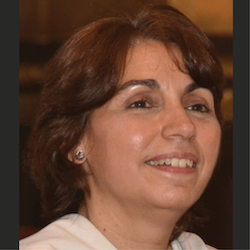
Sister Marilín M. Llanes, OP, a vowed member of the Adrian Dominican Sisters (ADS) whose life and ministry reflect a deep commitment to justice, community, and financial resilience. With more than 15 years of experience in community development, Sister Marilín currently serves as Office Director for shareholder advocacy and community impact investing the Portfolio Advisory Board (PAB).
Sister Marilín’s story began in Cuba and continued in Miami, Florida, where she settled with her family after immigrating to the United States as a young child. As a Cuban American shaped by diverse border influences and lived experiences, she brings a broad, compassionate perspective to her work with communities seeking opportunity and dignity.
Her ministry and professional path have consistently centered people too often left at the margins. In San Antonio, Texas, she managed legal clinics at St. Mary’s University Center for Legal and Social Justice and founded Urban Green Cleaning, a business that supported immigrants awaiting work permits. While at St. Mary’s University, she earned a Master of Arts in Mental Health Counseling and later continued her graduate studies in school psychology at Trinity University.
For two decades, from 2002 to 2022, Sister Marilín served as a bilingual licensed school psychologist in San Antonio, Texas; Joliet, Illinois; and Detroit, Michigan, accompanying students, families, and school communities with particular attention to those who were under-resourced and underserved.
Earned a Master of Arts in Community Development Policy and Practice from the University of New Hampshire School of Public Policy, further strengthening her work at the intersection of policy, advocacy, and community impact.
Sr. Marilín contributes her experience and vision through service on several nonprofit boards, including Charism Capital Fund, Mercy Community Capital, Partners for the Common Good, and the Adrian Dominican Sisters’ Camilla Madden Charitable Trust Board. Her work continues to open pathways toward more sustainable, just, and financially resilient communities.

Sunday, November 1 at 7pm ET on Zoom: Join Catholic Women Preach, FutureChurch, and four extraordinary preachers as we celebrate the 10th Anniversary of Catholic Women Preach the best way we know how - by preaching!
We'll gather for a beautiful Liturgy of the Word with Kayla August, Ann Garrido, Cecilia González-Andrieu, and Kerry Alys Robinson who will break open the texts and uplift a woman saint of their choosing.
Ten years of raising voices and renewing the Church. Ten years of preaching that widens the table. Ten years of shattering the silence. Come celebrate with us!
Advertise with Catholic Women Preach: email Russ at russ@futurechurch.org
