

Stephanie
Stephanie
Boccuzzi
Boccuzzi
Today's readings begin in an unlikely place: with Cyrus, a Persian king who God calls “anointed.” The Jewish people were in exile by the Babylonians for generations. They lost their land, their places of worship, and their society. Although a foreigner himself, Cyrus liberates the Jewish people from thethumb of the Babylonians, and they are free to go back to Jerusalem to rebuild the Temple. This is ahistoric moment - Cyrus, a man who worshiped other gods and never once called on the name of the Hebrew God, is called by that very Hebrew God a “messiah” and a “shepherd,” the only foreigner and non-Jew to be given this title which was also bestowed to David and then to Jesus. God says of him, “I have called you by your name… though you knew me not.” This unfamiliar king who carried no Jewish credential whatsoever is regarded with the highest of titles - God’s chosen liberator, an instrument ofGod’s justice, Israel’s free-er from slavery and oppression.
As board president of the Women's Ordination Conference, also known as WOC, I spend a good amountof my time in rooms — in-person and virtual — with women who have given their whole lives to the Church: theologians, spiritual directors, chaplains, women who have led retreats and sat with the dying, women who have done, in every meaningful sense, the work of ministry for the Church. WOC's mission is to advocate and pray for the ordination of women as priests, deacons, and bishops into an inclusive and accountable Roman Catholic Church — not a Church torn down, but one made whole enough toembrace those members who are and who have been called by name to serve. These women are told, inone way or another, that they know not the Lord - that their call isn't legitimate - and they should be satisfied with the limited options made available to them. Otherwise put, they are standing in front of a door that others forbid them to walk through. The question, then, is who gets to decide the validity of one’s vocation?
Today's Gospel takes up that same question, though at first it looks like a completely different story. The Pharisees come to Jesus with a question rigged to have no safe answer: "Is it lawful to pay the census taxto Caesar or not?" Say yes, and Jesus is a collaborator with Rome. Say no, and he's a rebel against theempire. It's not really a question. It's a trap dressed up as one, built to force Jesus into a binary that serves the people asking it, not the truth.
Jesus doesn't take the bait. He doesn't accept the terms of this trap. He declares, "Repay to Caesar what belongs to Caesar and to God what belongs to God" isn't a clever dodge — it's a refusal to let a system define the boundaries of what's possible. He names something bigger than the binary he's been handed. Today's psalm also reminds us what that bigger thing looks like: a God who "governs the peoples with equity" — not by rigidity and hard lines, not by gatekeeping and exerting institutional power, but by a justice wide enough to hold everyone the world tries to leave out, dismiss, or invalidate.
I think a lot of church conversations about women's ordination get set up the same way the Pharisees set up their question. Are you for the tradition, or are you for change? Are you faithful, or are youdisruptive? Do you love the Church, or do you want to remake it? These are not real questions either.They're also traps dressed up as choices, and too many women and people of all gender identities have spent decades being forced to answer them on someone else's terms.
What would it look like to do what Jesus did — to name what actually belongs to God, instead of accepting the binary we've been handed by this world?
I think it looks like Cyrus. Called by name, used by God, a Persian, entirely outside the structure that would have recognized him as legitimate - yet he is a messiah.
I think it looks like every woman I've sat across from who keeps leading, praying with, and accompanying God's people despite the Church withholding full affirmation of her gifts.
I think it looks like Paul's words to the Thessalonians, giving thanks not for titles or standing, but for the "work of faith and labor of love and endurance in hope.”
Like many, I ask for the courage to refuse binaries and the set up of false choices, and instead to take heart to keep naming what belongs to God even when someone hands me a coin and asks me to pick a side.
So I pray to the God who loves us: give us the courage Jesus had before the Pharisees — to refuse an unjust question, and to name what belongs to you rather than the choice we've been handed. Make us a people who govern with equity, who widen the table rather than guard it. And when we are weary of waiting, remind us: you have called us by our names. We are yours.
We ask this in the name of Jesus, who broke every binary set before him. Amen.
Stephanie Boccuzzi
Stephanie Boccuzzi
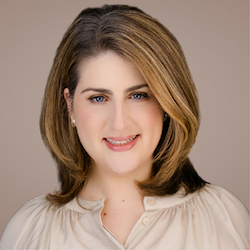
Stephanie Boccuzzi is a former theology teacher, writer, speaker, and the Board President of the Women's Ordination Conference, working to advance the full participation of women in the life and leadership of the Catholic Church. She holds a Master of Divinity from the Jesuit School of Theology of Santa Clara University and has worked with a range of nonprofit organizations both in the United States and abroad. In her last role, she served as Mission Leader for Trinity Health of New England. In recent years, she has become an advocate for the chronic illness and disability community, drawing from her own experience living with Myasthenia Gravis and ME/CFS. A continued area of focus and passion is reimagining the workplace as an adaptive environment that meets the needs of all people — whether through coaching, formative exercises, retreat experiences, building or strengthening employee resources, or challenging existing organizational systems. She lives in Bucks County, Pennsylvania, where you can find her exploring with her nieces and nephews, watching a lot of tennis, dabbling in watercolor painting, and enjoying small-town life.

October 17 at 7pm ET: Join Catholic Women Preach, FutureChurch, contributors to the Year C book, and co-editors Elizabeth Donnelly and Russ Petrus as we celebrate the release of the third and final volume of this ground-breaking, award winning series.
"Catholic Women Preach is one of the more inspiring collection of homilies available today. Based on the deep spirituality and insights of the various women authors, the homilies are solidly based on the scriptures and offer refreshing and engaging insights for homilists and listeners. The feminine perspective has long been absent in the preached word, and its inclusion in this work offers a long overdue and pastorally necessary resource for the liturgical life of the Church." - Catholic Media Association
Advertise with Catholic Women Preach: email Russ at russ@futurechurch.org
