

Lisa
Lisa
Amman
Amman
There were five wise and five foolish virgins. All ten carried lamps. All ten were virgins. All ten appeared to be ready.
St. John Chrysostom explains that the lamps represent virginity and holiness, while the oil represents almsgiving and care for those in need. The lamps are the outward vessels; the oil is the inner life of virtue, mercy, and good works.
Virginity can be a beautiful sacrifice. It can free someone from certain attachments and create more freedom to serve God, especially in the least of these and those made poor. But virginity is not the point in and of itself. St. John Chrysostom goes so far as to say that it is foolish to make this great sacrifice if the sacrifice leaves no room for love of neighbor.
The question isn’t simply whether we have lamps; it’s whether we have oil. It is a question of how we live our discipleship in Jesus.
Can you think of a foolish sacrifice you’ve made? Maybe you’ve spent money on something that served no one particularly well. Maybe you sacrifice half of your Sunday every week to attend worship, but then forget to go forth to love and serve the Lord for the rest of the week.
Not every sacrifice is wise. It depends on what our sacrifices serve. Are they serving God’s purposes?
We can know God’s purposes. The prophets tell us that God desires more than outward religious observance. Jesus echoes this unmistakably at the end of Matthew 25: when we feed the hungry, give drink to the thirsty, welcome the stranger, clothe the naked, care for the sick, and visit the imprisoned, we are doing these things for Jesus, to Jesus. These are not optional extras in a life of faith. They are what faith looks like when it is filled with the love of God and neighbor.
Our faith, prayer, worship, and sacrifices do matter. They are our lamps. But they must be filled with the oil of mercy, justice, and love to bring the light of Christ to our world.
But how do we know what God is asking of us in our own lives?
Today’s first reading tells us that Wisdom is readily perceived by those who love her. What God desires is not a secret. Wisdom hastens to make herself known. So when we pray, we can ask God directly: What is the next thing you are asking me to do, especially for the least of these?
In Minnesota this past winter, during Operation Metro Surge, when ICE was taking family members using fear, violence, and weapons, there was so much pain and suffering. At one point in my prayer, I cried out to God because I didn’t know what to do. I wanted it all to stop. I knew I couldn’t fix everything, but I asked God to show me what was mine to do. Each time I prayed this prayer, a concrete, doable contribution I could offer surfaced or became clear within a matter of days. My job was simply to follow through, and then return to prayer and ask what to do next.
Jesus isn’t asking us to fix everything, but he is asking us to respond to the people and needs placed before us. Take a moment and reflect on the people in your life and in your wider community. Who is hungry or thirsty, and what can you share? Who is isolated, and whom can you visit? Who is a stranger, and how can you welcome them? Who is suffering, and how can you help them? We pray, we discern, and then we follow through.
Now I want to be careful about something: this parable is not about being perfect. Before I understood that the oil represented a whole lifetime of choices, and that the sleeping virgins represented death, I was very upset with God. Why would God shut people out of heaven because they forgot some oil, because they weren’t perfect at one particular moment? It felt like a “gotcha.” I thought of my dear friend Joy, who as a child lived in fear of Jesus’ second coming. She imagined coming home from school to find herself orphaned, because God had taken her parents to heaven but left her behind.
No, perfection is not the main lesson of this parable. Matthew is, however, concerned that we might say all the right things, join the church, and profess our faith, and then fail to actually do the will of God. This is about how we live, not just what we believe. We are being warned not to arrive at the end of our lives with our lamps empty.
Finally, the parable ends with the foolish virgins outside the heavenly banquet. We can trust in God’s mercy at the end of time and still hear the urgency of the warning in this parable. We must not assume there will always be another opportunity to repent, to repair, to make amends, especially here on earth.
I once attended a funeral where the deceased woman’s ex-husband showed up. He had been abusive, extremely abusive, during their marriage. At the sign of peace, he approached her parents to shake their hands. Her mother turned away. I understood her response as saying with her body: I cannot receive this gesture as peace when there has been no repentance, no amends, no real acknowledgment of harm. Her father, who was raising the children, chose to extend his hand.
I debated what I would have done, and what God would have wanted me to do. I can truly understand both responses. Thankfully, we are not the ultimate judges of one another. But an outward gesture is not the same as repentance, and a sign of peace cannot substitute for the hard work of making peace. The opportunity to make amends with his ex-wife was gone. She had died.
That is why Jesus tells us to be watchful. It is not because we must be perfect or live in fear, but because the opportunities to love, to repair harm, to feed the hungry, welcome the stranger, care for the sick, and visit the imprisoned are given to us in this life. We cannot assume there will always be another chance.
Our hope is in the mercy and redeeming salvation of Jesus, even in the face of terrible human failures. But while we can, let us seek God’s wisdom. Jesus has shown us what a life of faith looks like. Let us not only be people who carry lamps; let us fill them with the oil of mercy, justice, and love.
Don’t wait.
Lisa Amman
Lisa Amman

Lisa Amman lives in St Paul, MN with her husband and two daughters. As a member of the founding staff of Discerning Deacons, she engages Catholics in the active discernment of our Church about women and the diaconate and empowers Catholics to contribute to the renewal of the diaconate for our times. Lisa is currently participating in the inaugural cohort of PROCLAIM, where she is delighted to deepen her gifts for preaching. Lisa has learned, prayed and worked in Catholic institutions her whole life. She served for five years as the director of social justice at her parish in St. Paul, and then worked for 10 years as a community organizer with ISAIAH, an alliance of more than 100 faith congregations. She has coached, mentored and trained thousands of lay and ordained people of faith to advance the Gospel vision of justice and equal dignity in public policy and carried these gifts into service for our synodal church.
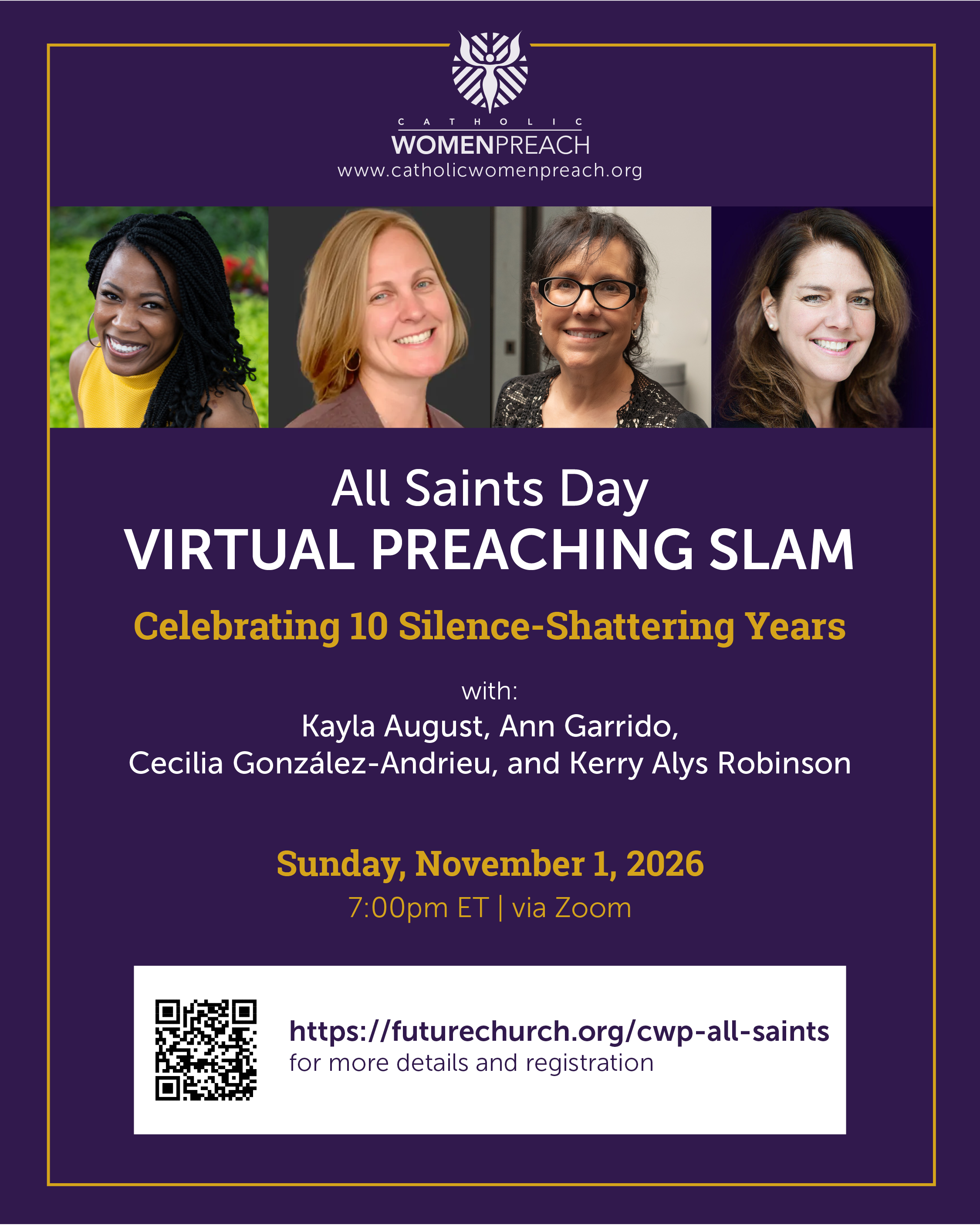
Sunday, November 1 at 7pm ET on Zoom: Join Catholic Women Preach, FutureChurch, and four extraordinary preachers as we celebrate the 10th Anniversary of Catholic Women Preach the best way we know how - by preaching!
We'll gather for a beautiful Liturgy of the Word with Kayla August, Ann Garrido, Cecilia González-Andrieu, and Kerry Alys Robinson who will break open the texts and uplift a woman saint of their choosing.
Ten years of raising voices and renewing the Church. Ten years of preaching that widens the table. Ten years of shattering the silence. Come celebrate with us!
Advertise with Catholic Women Preach: email Russ at russ@futurechurch.org
