

Annie
Annie
Selak
Selak
Watching and Listening: An Advent Invitation to the Margins
Happy Liturgical New Year! In just over a month, many of us will be thinking of new year’s resolutions, or intentions for the coming year. In our community of faith, we begin the liturgical year with Advent, a time of preparation for receiving God into our lives in a particular way— in the incarnation, the word made flesh, dwelling among us.
As we begin this season of Advent, and this liturgical year, we do so with a clear directive in the Gospel:
Watch.
Sometimes the Gospels are vague in what they are telling us, laced with symbols and customs that take some significant decoding. But this passage, well this passage is about as clear as it can be.
Be watchful. Be alert.
To be completely honest, I think this is probably the worst advice I could receive right now. In a culture saturated with videos and clips, I feel like I am constantly watching things. I scroll on my phone without realizing that I am, watching clips of tv shows followed by parenting advice and interspersed with women’s soccer highlights, or whatever the Almighty Algorithm has calculated to show me today.
Even at the gas station, a video plays while I fill up my car, because even that two minute period needs to be filled with watching.
I am watching things all the time.
And the call to be alert? We only need to turn to the plentiful amount of studies on burnout culture to show that people today, and in a particular way, women, are stuck in a cycle of fight or flight due to always being on alert. Our tendency to watch and scroll puts us on high alert, because sometimes that parenting advice is about how to keep children safe in school shootings, or the television show is true crime, or there is a newsclip of famine or war or violence or any number of things.
Be watchful. Be alert. These are the calls to the community called church that we are beginning the new liturgical year. And like any new year’s resolution, there’s a significance in starting the year with this call. There’s a sense that this will set the tone for the entire year, acting as an intention for the year.
Of course, the Gospel isn’t referring to the types of watching and alertness that I am talking about here.
Reframing watchfulness as listening is helpful for me. Listening feels less like I am inundated with things filling my eyes and mind and more like I am heeding a call from God to strip away the distractions, the 30 second clips fighting for my attention, in order to refocus on the presence of God in our midst.
It is not enough just to listen.
What are we listening to? The object of that preposition is critically important. Are we sifting through the noise that is constantly around us? Are we surrounded by an echo chamber, so that we can only listen to those who affirm our opinions and world views?
Or are we listening as God listens— to the outcast, the marginalized, the stranger, the migrant?
To whom or to what we listen is just as important, if not more important, than the act of listening, watching, or being alert. By starting with the lived experience, even if, or especially if those experiences signal a sense of a fracture between the Gospel we talk about in church and the difference in the lived reality, we affirm that God is really, truly present in our world.
In his recent encyclical Magnifica Humanitas, Pope Leo XIV spoke about the communal role of listening, saying:
“Created in the image of the Creator, our own work in some way continues [God’s], for thereby we contribute to the progress of society and the common good, put to good use the capabilities we have received, improve and beautify the world, support our families, engage in cooperative relationships and, through listening and dialogue, learn to build together something that no one could achieve alone.” (MH 148)
This call to the common good, or building something that none of us could achieve alone, is a beautiful call for the start of the liturgical year. And as the ancient practice of synodality is being affirmed in the contemporary church, we once again can notice that listening is a communal act. It moves me from just a relationship between me and God, and instead to a relationship of me, God, and community.
God did not finish revelation, or tell us everything there is to know about God in the past— God continues to be present with us today. In the peripheries, in the margins, in the moments of angst as well as the moments of joy, God reveals Godself to us.
And this connects to the first reading, which concludes with the image of God as the potter and us as the clay. The potter and the clay may be two entities, but in the act of creation, the potter shapes and throws the clay in such a way that it is infused with the style of the potter.
There’s a relationship between the potter and the clay. Each piece is unique and influenced by the context. It is not a cookie cutter replication process or an AI produced image of perfection. No, the clay is formed and shaped by the potter, taking on a likeness of the potter that is recognizable.
By listening to the marginalized, by placing ourselves in the hands of the Creator, we might take on the style of Creator, living into our divine dignity, affirming that we all are created in the image and likeness of God.
And because we are all created in the image and likeness of God, when we listen to one another, we are engaging in the holy listening of God’s presence in our world.
This call to listen, to be watchful, to be alert, can be misconstrued or it can be romanticized. It isn’t easy to listen to one another. It isn’t easy to make space for God in our lives. But it is possible through and with one another. It is possible in a community that we call church.
As we begin this new liturgical year together, let us do so knowing that God is the potter, and we are the clay. Indeed, we are the work of God’s hands.
Annie Selak
Annie Selak

Dr. Annie Selak (she/her/hers) is an expert in feminist ecclesiology. She studies wounds in the church, or moments where the church fails to live into its mission and causes harm.
In The Wounded Church: Tending to the Harm within Catholicism (Fordham University Press, 2026), Selak argues that the Catholic Church must confront its own injuries in order to credibly be Church. Using a feminist framework, she develops a new ecclesiology around three wounds, racism, sexism, and clericalism, that actively harm the Body of Christ and distort its witness. Selak integrates the lived experience of women with a robust vision for the church.
Selak serves as a Visiting Scholar in the Center on Faith and Justice at Georgetown University. She earned her Ph.D. in systematic theology at Boston College and M.Div at the Jesuit School of Theology at Berkeley. Selak has over 15 years of experience in Catholic ministry, and her writing has appeared in Modern Theology, Journal of Catholic Social Thought, Washington Post, National Catholic Reporter, Commonweal, and America.
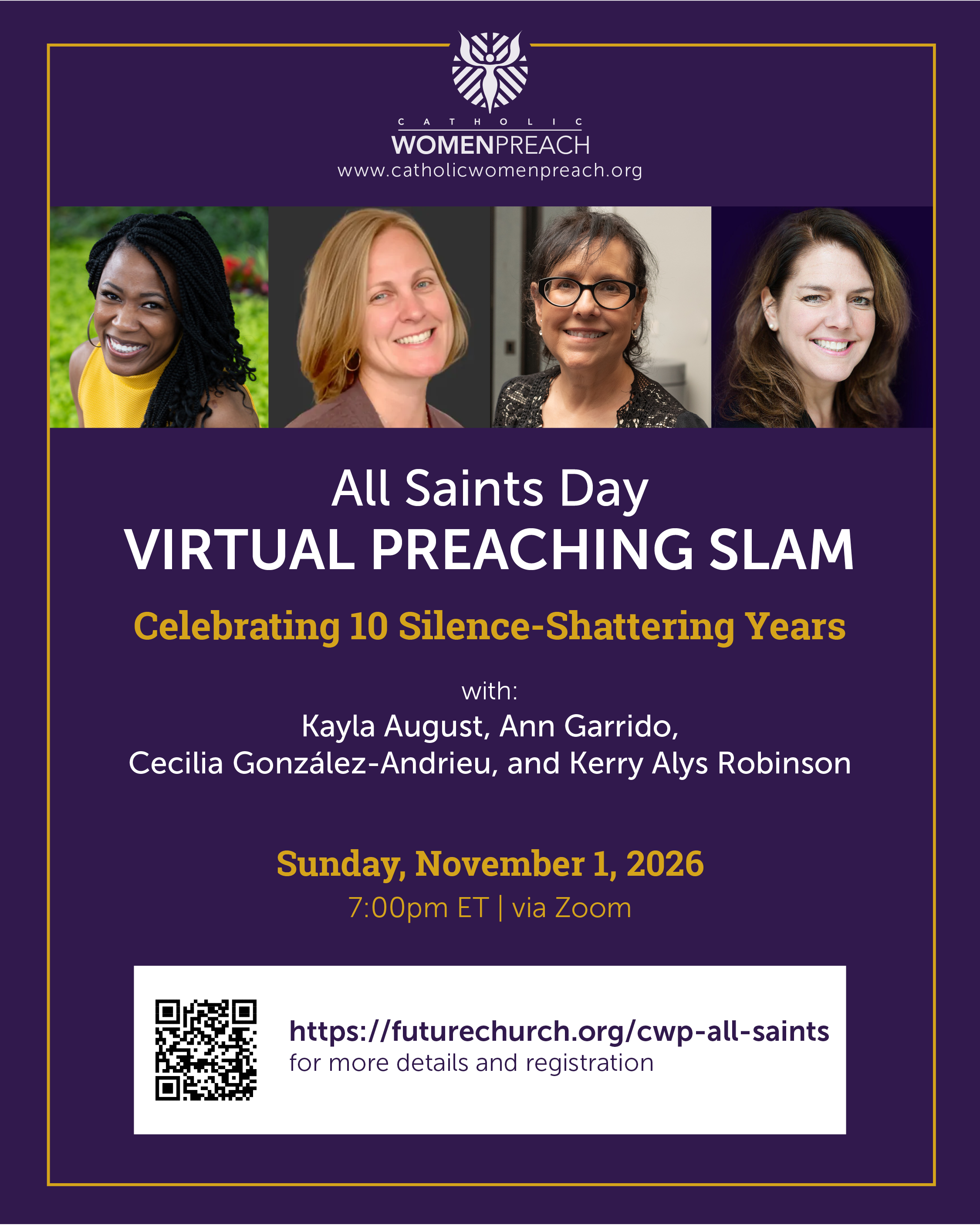
Sunday, November 1 at 7pm ET on Zoom: Join Catholic Women Preach, FutureChurch, and four extraordinary preachers as we celebrate the 10th Anniversary of Catholic Women Preach the best way we know how - by preaching!
We'll gather for a beautiful Liturgy of the Word with Kayla August, Ann Garrido, Cecilia González-Andrieu, and Kerry Alys Robinson who will break open the texts and uplift a woman saint of their choosing.
Ten years of raising voices and renewing the Church. Ten years of preaching that widens the table. Ten years of shattering the silence. Come celebrate with us!
Advertise with Catholic Women Preach: email Russ at russ@futurechurch.org
