

Sarah
Sarah
Riggio
Riggio
I believe the common language of the Kingdom of God is the Beatitudes.
I learn this from the most unlikely of teachers. Nearly everyday I minister alongside migrants who are required to attend ICE check-ins. I provide a Hospitality table with free coffee “Cafe Gratis” and often get to offer companionship as well. In this place I met Abdullah- my new friend from Sudan. Abdullah fled his war ravaged home and journeyed through 15 countries to come to the United States, seeking asylum (and all of what that represents— safety, yes, but also hope for a better life, an opportunity to live and thrive). He came knowing only Arabic, his mother tongue. He entered the country and asked for his legal right to seek asylum. Our nation, in this moment of history, forced him into a detention center for months. Upon release from detention, he entered life in the United States and knew he needed to learn English. With next to no money, and no relational contacts, but with all the resourcefulness and resilience he had within him, he taught himself English. How? I marveled. He shared with me “Americans are too busy, no one had time to even speak with me, to help me learn. But I looked around and said ‘who has time?’ The homeless have time.” So Abdullah bought bottled water and shared water with people on the streets in exchange for conversations in English.
One with nothing, learning from others with nothing. One poor in spirit, connecting with others who are poor in spirit.
There is something beautiful, something holy, in learning from those with nothing. This story from Abdullah has expanded for me the upside-down nature of the Kingdom of God: this radical vision that Jesus lays forth in the Sermon on the Mount, beginning with the words “Blessed are the poor in spirit, for theirs is the Kingdom of God.”
I have often imagined (and hoped!) that entering the Kingdom of God will be nothing like the process migrants endure entering our own nation. And yet, I have wondered about the concept of the Kingdom of God and what, if any, parallels exist. I have imagined this through the notion of language, and wondered: what is the language of the Kingdom of God? If I want to enter, what language must I learn?
I believe the language that Jesus speaks, the language of the Kingdom of God, is the Beatitudes. A language that expresses itself in words, but more so, in an active, lived expression. Jesus spoke poor in spirit, in the incarnation, taking on the frailty of human existence. Jesus spoke mourning when he grieved over the lost city of Jerusalem like a mother hen. Jesus spoke meekness when he took up a towel and washed his disciples’ feet. He spoke hungering and thirsting for justice when he cleansed the temple, and he spoke mercy as he forgave his enemies and refused to condemn the tax collector and the sinner.
For many of us, this language is not our mother tongue. It may not come naturally. We may question, where is the Duolingo or immersion program to teach us fluency?
How do we learn? As someone who is currently attempting to learn to speak Spanish, I know it takes practice, stumbling through, and above all a willingness to feel uncomfortable. And one of the best ways to learn is to speak with native speakers. Like my friend Abdullah, we can buy bottled water and sit with those who do speak it. Even if it is uncomfortable, especially when it is uncomfortable, we allow those who are poor in spirit to be our teachers.
On this great feast of All Saints- I imagine the saints- the citizens of the Kingdom of God- as those who learned to speak the Beatitudes. The great cloud of witnesses can be our teachers as well. We can sit with Saints Francis and Claire of Assisi and learn poverty in body and spirit. We can drink with St. Rita of Cascia and St. Elizabeth of Portugal and learn how to become peace makers. We can listen to the stories of St. Oscar Romero and St. Katharine Drexel and learn how to hunger and thirst for justice. And we can pray with St. Josephine Bakhita, from the same Sudan as my friend Abdullah, and allow her to show us the real strength that lies in meekness.
In the book of Revelation we see this awesome vision of a multitude no one could count from every nation, race, people and tongue. We know our worldly tongues will comprise the languages of the Kingdom of God which is here and yet to come- there will be Spanish spoken, and Pashto and Arabic and Chinese and Umbundu and Lingala and Swahili and Portuguese and Mam— all in praise of God and Jesus Christ, our savior. But all of us, from every nation, from every race, from every tongue, will speak the Beatitudes. For as it says in the reading from 1 John, “we shall be like him” - like Jesus, the master teacher of the Beatitudes.
In our desire to live in the Kingdom of God, let us talk with the saints, and let us buy water and sit with, and learn from the poor in spirit in our midst, and thus become conversational, no…dare I say fluent, in the language of the Kingdom of God.
Sarah Riggio
Sarah Riggio
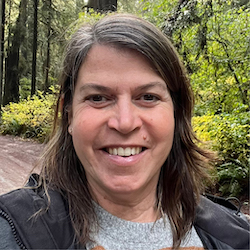
Sarah Riggio is a lifelong lay Catholic minister, who has found herself saying yes to God in a variety of ways such as college campus minister, high school theology teacher, volunteer catechist, Baptism and Confirmation coordinator, and a Pastoral Associate for Youth and Young Families.
She and her husband Brook, and their five children, reside in Seattle, WA and being a partner and mother is her great delight.
Beginning 7 years ago, she and her family chose to welcome refugees and asylum seekers into their home- a life changing experience that continues to this day. Through her relationships with migrants, and supported by her role as a Diakonia Fellow with Discerning Deacons, she most recently started a Hospitality Table, named Café Gratis, that supports and serves migrants outside of an ICE check-in facility. She is animated by radical hospitality, and loves that the Latin root in the word accompaniment, is “com pane” or “with bread.”
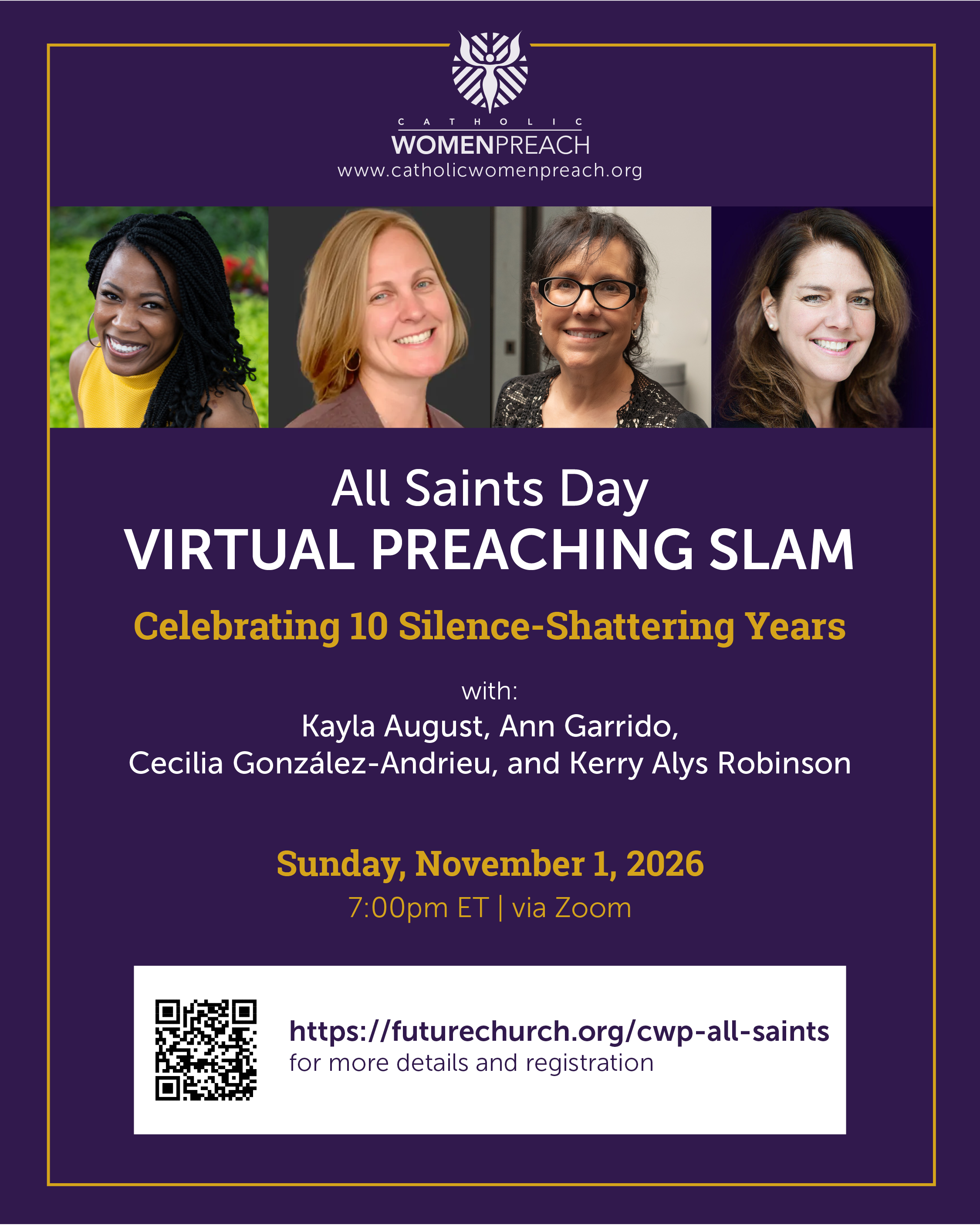
Sunday, November 1 at 7pm ET on Zoom: Join Catholic Women Preach, FutureChurch, and four extraordinary preachers as we celebrate the 10th Anniversary of Catholic Women Preach the best way we know how - by preaching!
We'll gather for a beautiful Liturgy of the Word with Kayla August, Ann Garrido, Cecilia González-Andrieu, and Kerry Alys Robinson who will break open the texts and uplift a woman saint of their choosing.
Ten years of raising voices and renewing the Church. Ten years of preaching that widens the table. Ten years of shattering the silence. Come celebrate with us!
Advertise with Catholic Women Preach: email Russ at russ@futurechurch.org
