

Ana María
Ana María
Pineda, RSM
Pineda, RSM
At this time of the year, I find that our days darken early leaving me longing for the light. It is also the season where the Latin American world celebrates Our Lady of Guadalupe’s appearance at a time of profound darkness. This year, I have been captivated by how her appearance occurred at the break of dawn, the moment when night gives way to day, and the hopes of the people of this land awakened anew. It seems that the experience of the Indigenous people is also one that our world yearns for—we, too, find ourselves in times of darkness, our hearts searching for the hopeful promise of a new day.
Is hope possible in times of darkness? We find the same haunting question present in the account of Our Lady of Guadalupe. In the account chronicling the conquest of the Indigenous world by the Spaniards, we hear the defeated Indigenous people cry out in desperation:
Our cries of grief rise up
And our tears rain down…
How can we save our homes, my people?
The Aztecs are deserting the city’
The city is in flames, and all
Is darkness and destruction.
The intensity of the people’s pain is so extreme that many lose hope and simply want to die…
The darkness of defeat is overwhelming. Yet, it is at that moment, that their cries and lamentations are answered. According to the account … it was Saturday, very early in the morning when a poor Indian man named Juan Diego was on his way to Mass and to receive Christian instruction. When he approached the little hill called Tepeyac, a sacred hill once dedicated to Tonantzin (the venerable mother and goddess of the Aztec people) dawn breaks…the dark night gives way to a new day with its promise of new life.
In Aztec cosmology and belief, daily existence followed the cyclical rhythms of day and night. Night left the world in a time of “waiting” and uncertainty—the people were left in an in-between-time—while dawn offered them the joyful promise of a new day.
As Juan Diego experiences the dark of night holding the dawn of a new day, he knew that a new moment of creation was being birthed. He stands in awe, and suddenly, he hears the beautiful singing of birds… “It seemed the song of different choice birds; at times the voices of the singers were silent; and it seemed that the mountains echoed them. Their song was sweet and pleasing.”
Juan Diego is overcome by its beauty. “He halted to look and said to himself: “Am I, perchance worthy of what I hear? Maybe I’m dreaming? Did I rise from asleep? Where am I? Maybe in heaven?’ He was looking toward the east, above the hill, from where came the marvelous, heavenly song; and as soon as it ceased, suddenly there was silence.”
He stops, looks around and tries to discover where the music is coming from…for Juan Diego, he is interpreting what is unfolding before him through the lens of his indigenous beliefs. He knows that the singing of the birds is telling him that a sacred spiritual event, and truth, is about to be revealed.
In that moment of silence, he hears someone calling him from the crest of the hill of Tepeyac: “Juanito, Juan Dieguito.” The tenderness of the voice draws him, and he is emboldened to seek it. The conquest had humiliated and devastated a once proud people. And Juan Diego would ordinarily not have ventured out, but as darkness gives way to the break of a new day, he is being drawn toward the light.
When he comes to the top of the hill of Tepeyac, he sees a Lady of glowing beauty. “He greatly marvels at her extreme, her surpassing, her perfect wonderfulness: her garments were radiant as the sun...and the land shone like a rainbow.” Her face has an expression of love and compassion. Juan Diego understands the imagery of the Lady…the Sun is a symbol for the divine, and she is standing in front of the sun. This tells him that she is a divine presence. The sparkling brilliance that surrounds her is a sign that the rupture of the Indigenous cosmos is being restored. The appearance of the Lady is transforming the world anew.
Upon reaching her presence, he kneels before the Lady and listens to her word, a word gentle and respectful. She continues: “Juanito, the smallest of my son, where are you going.” In her words, she recognizes his pain while acknowledging Juan Diego’s humanity and worth. He tells her that he is on his way to church where he is in the process of being Christianized.
To his surprise, the Lady has a request for him; she wants Juan Diego to ask the bishop to have a temple built there where she is standing. She says: “I have a living desire that there be built a temple, so that in it I can show and give forth all my love, compassion, help, and defense, because I am your loving mother: to you, to all who are with you, to all the inhabitants of this land and to all who love me, call upon me, and trust in me. I will hear their lamentations and will remedy all their miseries, pains and sufferings.”
The Lady directs Juan Diego to go to the bishop, and he immediately leaves her and goes on his mission. The narrative tells of Juan Diego’s repeated attempts to communicate the Lady’s request to the bishop, and how the bishop refuses to believe him.
Juan Diego feels belittled by the bishop’s disbelief and dismissal. He returns to the hill of Tepeyac and pours his heart out telling the Lady that he has failed, and that she should entrust this mission to someone else. Juan Diego’s words reflect the defeated spirit of the entire civilization to which he belongs: “You know that I am a nobody, a nothing, a coward, a pile of old sticks…I am nothing. You have sent me to walk in places where I do not belong.” The darkness, the hopelessness has returned.
But the Lady answers him: “Listen, my son, the smallest of my children—you who are most vulnerable—I want you to understand that I have many servants and messengers to whom I can entrust this message, but I want your help in fulfilling my request.” Once again, the Lady expresses her belief in him and in doing so continues to affirm his dignity and humanity. The darkness of the conquest is yielding to a new dawn, a new moment of resurrection from the ashes of defeat.
Filled with the love and confidence bestowed on him by the Lady, Juan Diego returns to see the bishop. But the bishop still refuses to believe that Juan Diego is telling the truth, so he demands that the Lady send him proof.
Once again, Juan Diego returns to the Lady to share the bishop’s request. She listens to him and asks that Juan Diego return the following morning to receive the requested sign. She sends him home with this reassurance: “know my little son that I will repay you for the care and the work and the fatigue that because of me you have undergone.”
The next morning Juan Diego does not return to the Lady because during the night, his uncle falls seriously sick and begs Juan Diego to call a doctor and seek a priest to hear his uncle’s confession. The next day, very early in the morning, as Juan Diego makes his way through darkness, he takes another route with the intention of avoiding the Lady in order to first fetch a priest to fulfill his uncle’s request, and then later seek out the Lady.
But the Lady is watching him from afar and comes down to meet him. Juan Diego is surprised by her appearance and shares with her the depth of his distress at his uncle’s pending death due to smallpox. In the following words the Lady assures him that his uncle who is dying will be restored to health and through him the restoration of the Indigenous’ dignity. “Listen and understand, my son the smallest of them, that it is nothing that which frightens and worries you, nor should another illness or another worry. Am I not here, who am your Mother? Are you not beneath my all-encompassing shadow? Am I not your health? Are you not within my lap? What else should you need? Nothing else though, should trouble you, should disquiet you. And do not let it trouble you, this pestilence of your uncle’s, that he will not die now from it. Be assured that I will heal him.”
The darkness of injustice and dehumanization will give way to the light of a new day not only for Juan Diego’s uncle but also for the devastated Indigenous nation. And the Lady’s words communicate an important message: the fact that all who seek her are in her loving embrace, and within the fold of her protective mantle.
Upon hearing the Lady’s words, Juan Diego is greatly consoled. His confidence is restored. He begs to be given the sign to take to the bishop. The Lady sends Juan Diego to the top of the hill where he finds “so many kinds of exquisite roses …before the season in which they blossomed, because in this season the frost was severe. They were very fragrant and filled with the dew from the night, and they looked like precious gems.” The roses are symbols of a night transformed into a new springtime for the defeated people. He gathers and places them in his tunic— “tilma”—drawing them to himself and thus embracing the “truth” of a resurrection promised to him by the Lady.
Juan Diego returns to the bishop and after gaining admittance, he unfurls the tilma. As he does so, the roses fall to the ground, and upon the tilma appears the image of the Lady…or as she is known today, Our Lady of Guadalupe.
Upon seeing the image of the Lady, the Bishop kneels before her and “with tears of sadness [prays] and [asks] her pardon.” He then places the tilma with her image in his oratory and invites Juan Diego to stay in his residence. The following day Juan Diego shows the bishop the place where the Lady asked for her temple to be built. Having completed his mission, Juan Diego returns home and finds his uncle healed.
In time, a Church was built on the hill of Tepeyac where the Lady had first appeared to the defeated indigenous man, Juan Diego, and the tilma with the image of Our Lady of Guadalupe was placed there.
It is this story that is emblazoned upon the heart of the Latino/a community, and it is in this story that a defeated nation finds comfort, consolation, and loving affirmation. Beneath Our Lady of Guadalupe’s star-covered mantle, they are reminded of their identity as dignified people who are worthy of respect. Our Lady of Guadalupe/La Virgen de Guadalupe is a sign of radiant hope for all people who struggle in darkness.
Ana María Pineda, RSM
Ana María Pineda, RSM
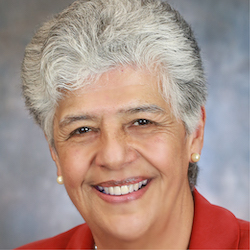
Ana María Pineda, RSM, STD, is a member of the Institute of the Sisters of Mercy of the Americas and is a tenured faculty member in the religious studies department at Santa Clara University.
Born in El Salvador, she came to the U.S. when she was two. Most of her life’s work has revolved around Hispanic ministry and theology both at the local and national level. Her early years included teaching and parish ministry to inner-city Hispanic/Latino families and mentoring Latino/a students. She was co-director of the Office of Hispanic Ministry and Hispanic Consultant to the Diocesan Catechetical Office in the San Jose Diocese and for 10 years was a faculty member and director of Hispanic Ministry Program at Catholic Theological Union in Chicago.
Nationally, she was involved in the earliest Hispanic Church dialogue in the national Encuentros and was a keynote speaker at the V Encuentro. She helped found the Academy of Catholic Hispanic Theologians in the United States (ACHTUS) and served as its President in 2000. She is a founding member of the Hispanic Theological Initiative (HTI) that supports Latino/as in theological doctoral studies.
Pineda is the recipient of several awards among them ACHTUS’ Virgilio Elizondo, the Inaugural Encuentros Award by the U.S. Conference of Bishops for her sustained and significant contribution to Hispanic/Latine Catholic Ministry. In 2021, La Comunidad of Hispanic Scholars of Religion presented her with the Lifetime Achievement Award for her contribution to Latinx Theology.
The author of Rutilio Grande: Memory and Legacy of a Jesuit Martyr and Romero and Grande, Companions on the Journey, Ana María has a B.A. in Liberal Studies from Russell College, Burlingame, Calif.; M.A. in Theology, Catholic Theological Union, Chicago, Ill.; and a Doctorate in Sacred Theology, Universidad Pontificia de Salamanca, Spain.

Sunday, November 1 at 7pm ET on Zoom: Join Catholic Women Preach, FutureChurch, and four extraordinary preachers as we celebrate the 10th Anniversary of Catholic Women Preach the best way we know how - by preaching!
We'll gather for a beautiful Liturgy of the Word with Kayla August, Ann Garrido, Cecilia González-Andrieu, and Kerry Alys Robinson who will break open the texts and uplift a woman saint of their choosing.
Ten years of raising voices and renewing the Church. Ten years of preaching that widens the table. Ten years of shattering the silence. Come celebrate with us!
Advertise with Catholic Women Preach: email Russ at russ@futurechurch.org
