

Nicolete
Nicolete
Burbach
Burbach
Today’s reading is a triumphant announcement of our vindication. We hear from Jeremiah, whom God is with “like a mighty champion” amidst his persecution. The Psalm proclaims that God hears the poor, and tells us: “see, you lowly ones, and be glad”. Paul teaches us that God vindicates us not just from our worldly oppressors, nor even from structures of sin, but from the very sin embodied within them. And finally, the Gospel teaches us to “Fear no one”—not even those who “kill the body”, because they “cannot kill the soul”.
These words witness to the hopes for justice and redemption of all who find themselves in the place of Jeremiah, all who are ground beneath the heel of sin, all who face death. They testify to truths we all know, but which are hard to hold on to in our time of cruelty and injustice.
Yet there are many who ought to be consoled by these words who will not be consoled. And there are many who ought to be troubled who will not be troubled.
Many of us will know how it feels to hear these words of consolation, and yet struggle to locate ourselves within them. There is also a harsh, if not violent undercurrent to them: Jeremiah asks that he might “witness the vengeance” God takes on his persecutors. Christ warns that we should fear instead “the one who can destroy both soul and body in Gehenna”, and promises to deny all those who deny him. We are encouraged to see ourselves as more valuable than sparrows, who fall to the ground, discarded by the text. So many of us are taught to hear these threats first, and consolations second. So many of us are taught to see ourselves not truthfully, as among the consoled, but falsely, as among the condemned.
Conversely, we all know how words such as these can be twisted to console oppressors and persecutors. Many who seek to oppress see themselves as oppressed when they are resisted or denied. They cry out when the refugee is not turned back at the border, complaining that their land is being stolen. They cry out when they encounter the trans woman in the toilet, demanding segregation and unsafety for the sake of their own comfort. They cry out when they are denied the right to shape society according to their prejudices, complaining that their liberties are denied.
Perhaps such readers see themselves as consoled by the text because they identify with its promises. Your life might seem close to a state of grace when you have had your reward: perhaps Jeremiah in his vindication is identifiable to those who are not persecuted. Perhaps the disciples under God’s protection are identifiable to those who are safe. Perhaps redeemed humanity is identifiable to those who see themselves as sinless.
So we might ask—what would it mean to read this text alongside those who don’t see themselves in its consolations? Those who are discarded even amidst its promises?
So we might ask—what about the sparrows?
The figure of the sparrows in today’s gospel reading is especially profound because of how it mirrors the very real way people have been discarded throughout history. The pseudonymous author of the Gospel encourages readers to compare themselves to sparrows, whose nonhuman lives are held so cheap as to be worthless. This comparison then helps the reader to form a picture of themselves as valuable and cared for. Meanwhile, the sparrows are left to fall, and the reader moves on to think of themselves.
Compare this now to the way that society treats people deemed to be nonhuman. Consider how Western so-called ‘civilisation’ was built on the literal backs of enslaved Africans. Denied the full humanity, they were instead reduced to chattel—or, as the Black feminist writer, Hortense Spillers strikingly puts it, commodified “flesh”. They, too, were sparrows, their lives the disposable material for constructing a world they never got to enjoy.
Consider, too, the sparrows of today: racialised minorities sacrificed to preserve Whiteness, immigrants sacrificed to preserve the Nation, trans people sacrificed to preserve cisness.
This also speaks to those who struggle to see themselves in the consolations of the text—who find it easier to imagine themselves among the condemned. The condemned in the readings are also ‘sparrows’ in their own way: it is by way of their suffering and ruin that the message of our vindication is constructed. And who then is called back to think of them? In this way, all those who ought to be consoled by the text but who hear instead their own condemnation are sparrows—the disposable material for constructing a reading allied to power.
I do not think the author of today’s Gospel was thinking of these issues. Yet, perhaps inadvertently, they speak to them. In just a small gesture, easily forgotten with the little sparrows themselves, Christ notes: “Yet not one of them falls to the ground without your Father's knowledge”.
Society may move on from the broken bodies of its sparrows, but God does not. Every one of them, even as they fall to the ground, does so in God’s knowledge.
Even when others do not see you in the Gospel’s consolations—even when you can’t see yourself—God still sees you. God still cares.
Nicolete Burbach
Nicolete Burbach

Nicolete Burbach is a theologian whose work aims to help the Catholic Church to navigate its difficult encounter with transness. She is particularly interested in how the late Pope Francis’ teachings might help the Church to take a more productive stance around things that it finds unfamiliar or threatening. Her research revolves around putting Francis into dialogue with work in queer theory around the relationship between politics, interpretation, and feeling. She is also interested in the history of Catholic antifeminism, especially in its most recent expression of transnational anti-gender politics, and the interface between theology and trans studies. Her edited collection with Lisa Sowle Cahill, Trans Life and the Catholic Church Today was published by Bloomsbury in 2024.
Alongside academic writing, Nicolete is a regular contributor to New Ways Ministry’s blog, Bondings 2.0, and has written for a variety of other organisations and publications, including The Tablet, Global Network of Rainbow Catholics, and The Pastoral Review. She also speaks widely and has been a guest on various podcasts, including The Magnificast and Thinking Faith’s Things I Wish I Knew.
Nicolete earned a BA(hons) in Philosophy and Theology, an MA in Catholic Studies, and completed a PhD on Pope Francis’ hermeneutics of uncertainty, all at Durham University. She now lives in London with her wife. In her spare time she plays guitar in multiple bands.
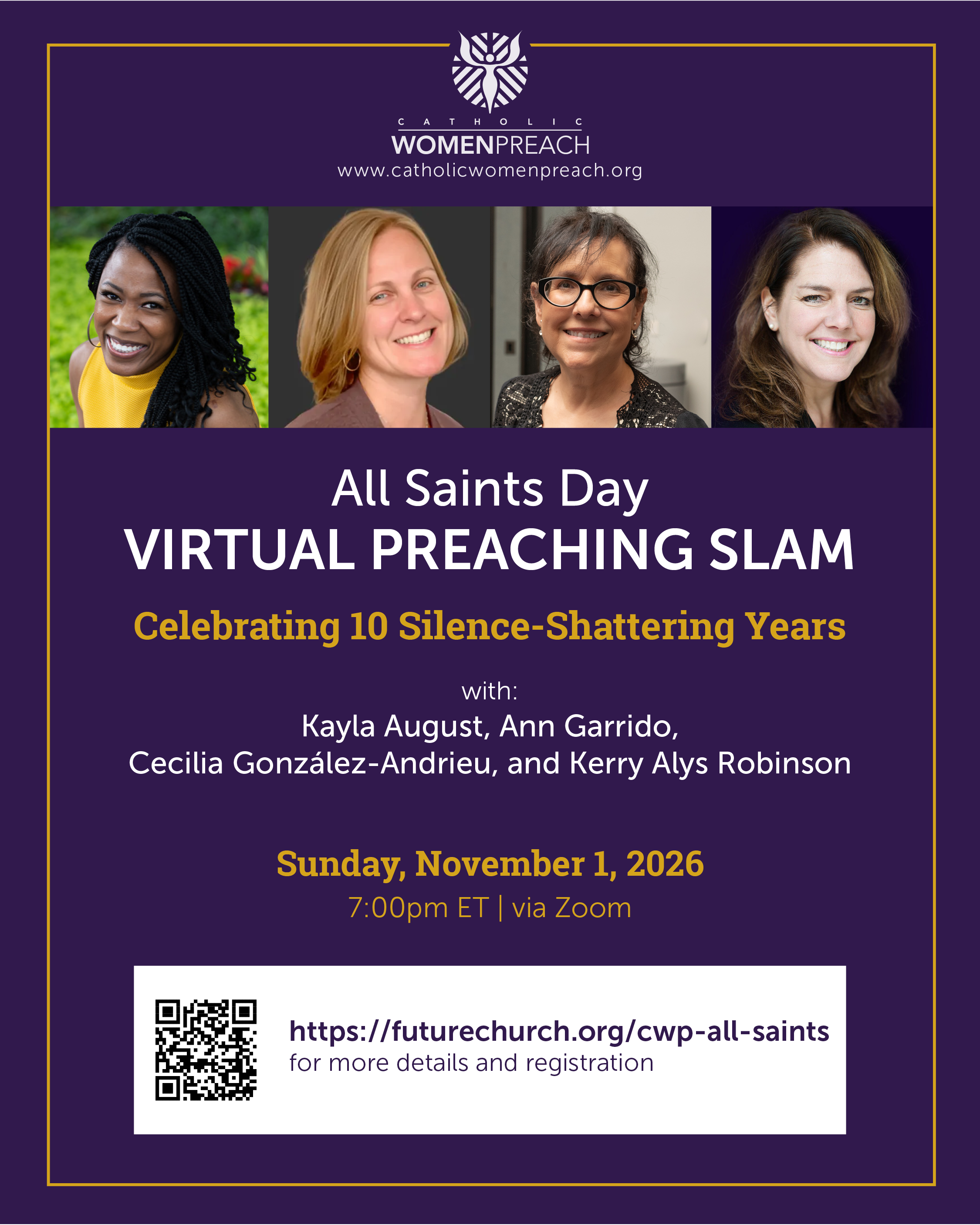
Sunday, November 1 at 7pm ET on Zoom: Join Catholic Women Preach, FutureChurch, and four extraordinary preachers as we celebrate the 10th Anniversary of Catholic Women Preach the best way we know how - by preaching!
We'll gather for a beautiful Liturgy of the Word with Kayla August, Ann Garrido, Cecilia González-Andrieu, and Kerry Alys Robinson who will break open the texts and uplift a woman saint of their choosing.
Ten years of raising voices and renewing the Church. Ten years of preaching that widens the table. Ten years of shattering the silence. Come celebrate with us!
Advertise with Catholic Women Preach: email Russ at russ@futurechurch.org
