

Elise
Elise
Gower
Gower
I received an invitation to join the Catholic Women Preach community back in March. My human tendency to put it off created the sacred space needed for Divine intervention. Here I am writing and recording this in May past the deadline. I am in awe of the threads of God’s holy weaving.
We celebrate Corpus Christi, the Solemnity of the Most Holy Body and Blood of Christ. John’s Gospel captures Jesus’ invitation, “I am the living bread…,” recognizing Christ’s real presence in the Eucharist. The term solemnity is important in definition and in its saliency to God’s Word this week. God chose to come to us in human form. We know the vulnerability of flesh; the possibility of being wounded.
This past month my partner and I accompanied her father, whom I lovingly called “Pop Pop,” in his final stage of life. For nearly two years, we served as his primary caregivers during a difficult cancer journey. He required daily wound care that was both gruesome and painful; I was his wound nurse. Our bodies, with which we receive and give love, became central. To tend to a body is constant, intimate, and sometimes grueling. Like that of Corpus Christi, it is about honoring the worth of God’s chosen body. Flesh and blood were not metaphor here. Together, Pop Pop and I were making an offering. It may seem easy to construe my role in this, but Pop Pop also gave his body. He allowed himself to be seen, touched, and known in his most diminished state. To receive care is not passive; it requires surrender - its own kind of courage.
Prior to Pop Pop moving in with us, he and I did not share a connection. I share the context that he struggled with our queer life - a real, present, largely unspoken tension. When we became roommates, our queer relationship was made visible and undeniable every single day. He could not abstract us, nor us him. Distance was no longer a barrier to hide behind. We were seeing one another authentically. I know this transformed us. Our differing views did not change, but our ability to see one another and eventually love one another was not beyond those differences but through them. Pop Pop held his tradition and he loved me. Both were true. The wound - literal and relational - became a site of encounter.
The first reading from Deuteronomy mirrors our present moment: a time of oppression, division, cruelty, and fear. Systems of exclusion exist in the isms of society, the saraph serpents and scorpions: racism, queer phobia, ageism, sexism, ableism, nationalism, power, and wealth. The desert becomes familiar. This reading reveals to us that God shows up in the desert in inconceivable ways - manna and water from rock. What does it mean that sustenance arrives in impossible places? I recognized this desert. I had been living in one.
There is something unique about this first reading. Moses is speaking to people after liberation - freed from the bondage of enslavement, but not yet home. The desert is the in-between. Queer life can feel like that in-between. We are no longer willing to be invisible, and we are not yet fully welcomed. But the Israelites have been liberated. Maybe liberation is not inclusion. To include is to exert power to decide who belongs, as if belonging-by-permission. Deuteronomy claims that God was most present in the desert. The particularity of flesh - Pop Pop’s body, my hands, our shared wound - is where God already was. We belonged to one another. Liberation moves through, not around. And it is in walking through the desert that Pop Pop and I discovered God’s ever-presence. In 1 Corinthians, Paul reminds us that our belonging, too, is ever-present. The work isn’t to earn, be granted, or achieve belonging; it is to recognize God’s truth: we though many, are one body.
The intimate language of this week’s Gospel hits me as I grieve the loss of our beloved Pop Pop. It reads, “... he remains in me and I in him.” It’s about presence, a dwelling place. Like the Eucharist, I carry Pop Pop not as a thought or a memory, but as a living presence that has shaped who I am today. In some theological sense, I imagine I was an embodied part of Pop Pop’s dying. That is resurrection made personal. So many people at Pop Pop’s funeral reflected that we were a blessing to him. We were quick to correct them; “He was our blessing.” The blessing is always mutual. The body is always one.
Where is your desert? Whose body are you tending to?
Sometimes the most faithful act is to tend to your own body, your own love, your own life in the name of a God who made us whole. Pop Pop witnessed that our (mine and my partner’s) bodies and our love are God’s creation. There is holiness in embodying this. To my queer community, what does it mean to be a sanctuary for your own Divine belonging?
Last week we celebrated Pop Pop’s life at his funeral. We listened to the words of John’s Gospel: Whoever eats my flesh and drinks my blood remains in me and I in him. Thank you Pop Pop for revealing this to me.
Elise Gower
Elise Gower

Elise Gower (she/her) is a queer, cisgender, white woman who lives in Silver Spring, Maryland. She is in her final months of graduate school at Louisiana State University where she is pursuing a master’s in clinical social work. Her career in ministry, community engagement, and leadership development fostered a commitment to cultivating intentional community around the tradition and values of Ignatian spirituality. Elise previously worked at various Jesuit institutions including The University of Scranton, Loyola University Maryland, and The Office of Ignatian Spirituality. She continues to lead retreats, offer workshops, and contribute writings connected to her professional interests. Elise has extensive experience working with individuals and groups, centering storytelling and its value in collective antiracism work and LGBTQ+ accompaniment and advocacy. She is passionate about the intersections of mental health, queer identity, and spirituality. This led to her recent career evolution and return to school; she soon plans to start a private practice to support people from various backgrounds and life stages as they process the experiences of intersectional identities, anxiety, depression, relationships, stress management, transitions, grief, trauma, and life’s unexpected moments. It is in this context Elise feels most authentically aligned in her discernment.
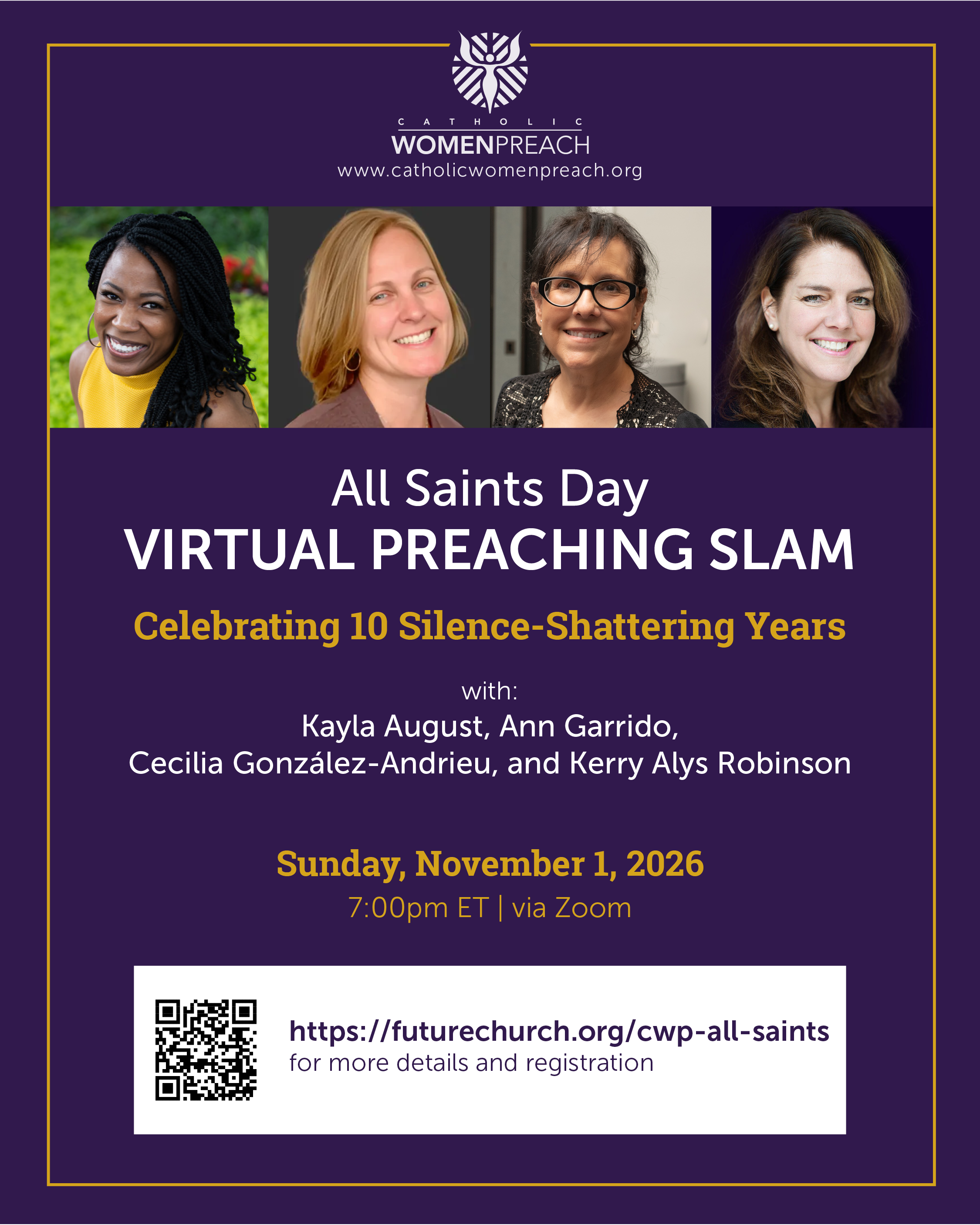
Sunday, November 1 at 7pm ET on Zoom: Join Catholic Women Preach, FutureChurch, and four extraordinary preachers as we celebrate the 10th Anniversary of Catholic Women Preach the best way we know how - by preaching!
We'll gather for a beautiful Liturgy of the Word with Kayla August, Ann Garrido, Cecilia González-Andrieu, and Kerry Alys Robinson who will break open the texts and uplift a woman saint of their choosing.
Ten years of raising voices and renewing the Church. Ten years of preaching that widens the table. Ten years of shattering the silence. Come celebrate with us!
Advertise with Catholic Women Preach: email Russ at russ@futurechurch.org
