

Martha Inés
Martha Inés
Romero Medina
Romero Medina
Pope Leo, in his 2026 World Day of Peace Message, invites humanity to reject the logic of violence and war, and to embrace an authentic peace based on love and justice. Pope Leo XIV advocates for a peace that does not depend on weapons but rather disarms inner violence and transforms relationships.
This peace -Pope Leo says- must be unarmed, that is, not based on fear, threats or weapons. And it must be disarming, capable of transforming conflicts, opening hearts and generating mutual trust and hope. It is not enough to call for peace; we must embody it in a way of life that rejects every form of violence, whether it be visible or systemic.
Why a nonviolent and unarmed peace?
Non-violence is a core value of the Gospel, in which Jesus combined an unmistakable rejection of violence with the power of love and truth in action for justice and peace. At its core, non-violence is firmly rooted in positive values such as love, compassion, empathy, and respect for all human beings’ inherent worth and dignity. And this principle requires to be unarmed.
How this peace could be unarmed?
Personal Change: it refers to the conversion of hearts – related to non-weaponized us, even thoughts and words. It is the way we cultivate prayer; we live our spirituality.
Relational Change: Pope Leo urges the abandonment of inner violence, promoting reconciliation based on love, justice and fraternity. One promising response to war and violence is the just peacebuilding approach, which focuses on violence prevention and restorative justice. At the heart of just peacebuilding is the intentional building of relationships at every level of society dedicated to nonviolent transformation of conflict, the pursuit of social justice and the creation of cultures of sustainable peace. It is promoting ecumenical and interreligious dialogue as paths of peace and as languages of encounter within traditions and cultures.
Cultural Change: to look beyond blood ties or ethnicity, beyond associations that accept only those who are similar and reject those who are different. With connection and respect: the message invites us to see the other not as an adversary, but as a brother or sister, overcoming fear.
Structural Change: promoting development through policies and practices that improve the necessary conditions for a lasting and unarmed peace.
Let’s reflect on the greeting of the Risen Christ, “Peace be with you” (Jn 20:19); it is an invitation addressed to everyone — believers and non-believers, political leaders and citizens — to build the Kingdom of God and to work together to build a humane and peaceful future.
Pope Leo mentions that it is not enough desire peace; he refers to a “lasting transformation” in which those who receive it are transformed and, consequently, the context when relations are happening is transformed. “Peace is more than just a goal; it is a presence and a journey.” So, true peace is Active and Transformative… Pope Leo says: “Peace is a breath of the eternal: while to evil we cry out “Enough,” to peace we whisper “Forever.”
How this transformation takes place?
Building Peace from a Nonviolent approach, following Nonviolent Jesus. It is a promising way of understanding the church’s teaching on war and peace. It is based both on a careful reading of the signs of the times, where the Spirit of God is acting in history, and a careful discernment of what the Gospel is calling us to do as a People of God.
“The peace of the risen Jesus is unarmed”. Jesus promotes the acceptance of suffering rather than responding to Violence with Violence. He encourages a peaceful approach even in the face of aggression, embodying the essence of non-violence.
Non-violent activists often demonstrate immense courage and resilience in the face of adversity. They are willing to endure hardship and make personal sacrifices to pursue their principles and convictions.
Loving God,
thank you for Pope Leo
and his message of a disarmed and disarming peace!
Thank you for being present in our darkest moments
and for giving us the strength to overcome them, through love, empathy,
and the ability to build peace within ourselves, with our neighbors, and with nature,
which is suffering under a destructive and polluting system.
Bless us in this world with so many piecemeal wars;
let us feel your strength and your power, now and forever.
Amen.
Martha Inés Romero Medina
Martha Inés Romero Medina
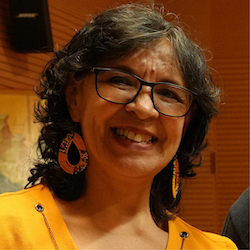
Martha Inés Romero Medina is a Colombian peace practitioner, with a MA in Development Project Management, studies in Peace and Conflict Transformation at Kroc Institute, Notre Dame University in the United States; and a Diploma in International Development Cooperation, Peace Institute, Oviedo University, Spain. Since 2023, Martha Inés has served as Secretary General for Pax Christi International, a Catholic global peace movement. In 2007 she joined PCI as a Board member; for 14 years she coordinated the Latin America and Caribbean Pax Christi Program on "Strengthening Communities’ Capacities to Resist to Extractivism -Mining, Agrobusinesses, others-, with Peacebuilding, Advocacy and Active Nonviolent Citizen Actions". Martha Inés has promoted the Catholic Nonviolence Initiative, a PCI program.
Before Pax Christi and for 20 years, Martha Inés managed development, humanitarian, peace and reconciliation programs for Oxfam-Great Britain and Catholic Relief Services (CRS). Since 2010, she advised Caritas Internationalis in Rome, Caritas Latin America and the Caribbean and Caritas Asia in the design of Advocacy Plans with a faith focus; as Consultant, Martha Inés also evaluated programs in Latin America for organizations based in Norway, Sweden, Canada, and the United States.

October 17 at 7pm ET: Join Catholic Women Preach, FutureChurch, contributors to the Year C book, and co-editors Elizabeth Donnelly and Russ Petrus as we celebrate the release of the third and final volume of this ground-breaking, award winning series.
"Catholic Women Preach is one of the more inspiring collection of homilies available today. Based on the deep spirituality and insights of the various women authors, the homilies are solidly based on the scriptures and offer refreshing and engaging insights for homilists and listeners. The feminine perspective has long been absent in the preached word, and its inclusion in this work offers a long overdue and pastorally necessary resource for the liturgical life of the Church." - Catholic Media Association
Advertise with Catholic Women Preach: email Russ at russ@futurechurch.org
