

Jordan
Jordan
Denari Duffner
Denari Duffner
Almost six years ago, in the days just after Christmas,
I was in the Palestinian city of Bethlehem,
on an interfaith pilgrimage
with Jews and Muslims,
Catholics and other Christians from Georgetown University.
I remember walking through Manger Square,
with its lights and Christmas tree,
and then crouching down in the Church of the Nativity,
kissing the spot which marks, where our tradition holds,
that Jesus was born.
But I also remember walking along the Wall,
its cement face towering over us and cutting through the city —
a reminder of the lack of rights that Palestinians have,
and a symbol of the occupation and oppression that they face.
Things were bad back then in Palestine and Israel.
I could have never imagined what would be happening now, six years later.
After the departure of the Magi in today’s Gospel reading,
the next scene is the flight of Jesus and his parents to Egypt.
Joseph had been warned in a dream
that Herod wanted to find and kill the infant Jesus.
And so the family left hastily from Bethlehem
and made their way to Egypt—
through Gaza.
Today, the Gaza Strip’s only Catholic church is
named for the Holy Family. Its pastor and parishioners
take comfort in knowing that Christ passed through their land,
and managed to find safety amid displacement and the threat of death.
Now, during the two years of the genocide in Gaza,
the parish itself has been a haven for families,
driven from their homes with their children,
unsure if and how they will ever return.
The neighborhood surrounding the church,
like much of the Strip,
has been reduced to rubble and ash.
And tens of thousands of people have been killed.
The photos I see from Gaza posted on social media everyday
seem to echo the words of Isaiah in today’s first reading:
“See, darkness covers the earth
and thick clouds cover the peoples.”
God would seem to be absent from Holy Land—
and, indeed, from many of our lives—today.
Suffering, death, and destruction characterize so much of our world.
Where could God be in any of that?
But today is the feast of the Epiphany:
when we celebrate that God in Christ was made manifest to us—
when, to use the words of St. Paul in today’s epistle,
“the mystery was made known to [us] by revelation.”
When God, who is infinite mystery, became present to us
in our own human flesh,
revealing who God is in the tiny body of newborn baby.
God’s appearance to us, whether to the Magi in first century Palestine
or today wherever we are,
often doesn’t take away our suffering.
But it reminds us that God is present to us precisely amid that hardship.
Today’s feast—of God’s self-manifestation to us—reminded me
of passage I read several months ago from a Palestinian Muslim writer
named Dr. Alaa al-Qatrawi.
Dr. Alaa is an essayist and poetess from northern Gaza.
She, like me, is a mother in her mid-thirties.
But her children—all four of them—were killed in an Israeli bombing in 2023.
Since their deaths, she has continued write—beautifully—
not just about her children, but also about her relationship with God.
She writes: “I do not know what to call northern Gaza,
but it most resembles the verse of the Qur’an that says:
‘Wherever you turn, there is the face of God.’
It is as if I feel that the outpouring of Allah Almighty is manifesting itself
in every atom in the northern Gaza Strip….
Today we say, if you want to see the face of Allah manifesting in all directions,
go to [northern Gaza].”
As my colleague Farah al-Sharif has explained:
For Muslims, “Gaza has reaffirmed their faith rather than weakened it.”
If you ask Palestinians there, ‘Where is God?’,
“they will proudly and without hesitation declare,
‘He is always with us, He is here.’ They know God. They’ve experienced God.”
This profound confidence in God’s closeness amid suffering
is also felt by Gaza’s Catholics, like a young woman sheltering in the parish
who I correspond with periodically.
After the Church was hit by an Israeli missile in 2025, killing three people,
she wrote:
“Despite all this pain that tears at our souls,
and all the despair that surrounds us,
our faith in God remains the only light that illuminates our dark paths,
giving us the strength to endure another day.
We hold on to prayer…believing that God will not abandon us
and that after hardship comes ease.”
On this feast of the Epiphany,
let us learn from these teachers in Gaza—
to look for God manifesting in all directions,
even amid the worst moments of life.
For, as Isaiah promises,
God “shall rescue the poor when he cries out”
and the light of the Lord will shine on Jerusalem.
Jordan Denari Duffner
Jordan Denari Duffner
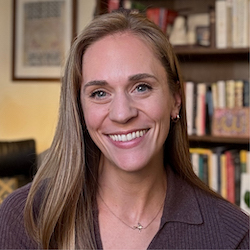
Jordan Denari Duffner, PhD is a Catholic theologian, author, and professor whose work centers on Muslim-Christian relations, interreligious dialogue, Islamophobia, and Israel-Palestine.
Dr. Duffner holds a Ph.D. and M.A. in Theological and Religious Studies from Georgetown University, where she also completed her bachelor’s degree in international affairs. She is currently a Scholar in Residence at the Shoulder to Shoulder Campaign, as well as she is a member of the Catholic Advisory Council of Churches for Middle East Peace (CMEP), which advocates for justice for all in Israel-Palestine. Formerly a Fulbright scholar in Amman, Jordan and a research fellow at Georgetown’s Bridge Initiative, she is also a Research Associate of the Centre for Muslim-Christian Studies and a member of the U.S. Conference of Catholic Bishops’ National Catholic-Muslim Dialogue. Her award-winning books are Finding Jesus among Muslims (2017) and Islamophobia: What Christians Should Know (and Do) about Anti-Muslim Discrimination (2021). She lives with her husband and two young children outside Washington, D.C. She writes on dialogue, spirituality, and more at Digging Our Well, a publication on Substack.

October 17 at 7pm ET: Join Catholic Women Preach, FutureChurch, contributors to the Year C book, and co-editors Elizabeth Donnelly and Russ Petrus as we celebrate the release of the third and final volume of this ground-breaking, award winning series.
"Catholic Women Preach is one of the more inspiring collection of homilies available today. Based on the deep spirituality and insights of the various women authors, the homilies are solidly based on the scriptures and offer refreshing and engaging insights for homilists and listeners. The feminine perspective has long been absent in the preached word, and its inclusion in this work offers a long overdue and pastorally necessary resource for the liturgical life of the Church." - Catholic Media Association
Advertise with Catholic Women Preach: email Russ at russ@futurechurch.org
