

Rhonda
Rhonda
Miska
Miska
One day in second grade, Mrs. Craddock handed back an assignment. Red ink marked where I’d copied down words from the chalkboard wrong. And I noticed in gym class and recess, I had a hard time catching a ball when someone threw or kicked it from a distance.
Someone suggested I get my eyes checked. My mom took me to Dr. Connors’ office, I learned I was nearsighted and I got my first pair of glasses.
The impact was immediate and powerful. I stopped squinting, which I hadn’t known I’d been doing. The words on the chalkboard became perfectly clear. No more red ink. During kickball games I saw the ball coming my way. Riding my bike through Lakeview Park, the leaves on the trees were brighter and crisper. The world was new.
Nothing had changed, but everything had changed.
The Beatitudes have the same power. They are seen by some as a canon within the canon, distilling the heart of Jesus’ teaching. Jesus is like Moses, giving divine teaching from a mountaintop.
But these nine Beatitudes? They are harder to understand than the ten commandments.
For the first listeners impatient for a warrior king like David, for us today who long for a just peace, these words can be jarring: Meekness? Mourning? Poverty and persecution? Not what we want to hear.
But something bigger’s at work here.
Whatever level of vision we have in our literal eyes, I think the Beatitudes give us a way to perceive the world and ourselves.
Without Beatitude lenses, looking through the eyes of this world, the news directs my attention to wealthy people in powerful positions - their private jets, over-the-top parties, and general bad behavior.
Without Beatitude lenses, online algorithms serve up beautiful influencers performing happiness, health, and success, and I really believe they’ve got it figured out. Big homes, exotic vacations, professional success. They’re winning at life. It distorts my desires and values.
But with the Beatitudes on, my vision corrects. Life comes into focus. The distortions go away. Domineering leaders, smiling influencers, glamorous celebrities are suddenly small and dim. What looked so shiny is now dull.
With the Beatitudes on, what was invisible comes into focus: millions of people around the globe hurting because of USAID cuts, women in crisis pregnancies, people in prisons and detention centers, families sheltering in place for fear of ICE - all of them turning to God because that’s the only place to turn. These countless people, beloved by God but invisible in a throwaway culture - their faces become clear and radiant through Beatitude lenses.
With the Beatitudes on, anonymous people and their hidden acts of compassion are suddenly visible - brilliant and shining.
People doing the ordinary, hard, daily work of caring for children and elders.
The social worker slogging through paperwork to help someone access housing or mental health treatment.
School teachers quietly finding ways for students to have food over holiday break.
The weary foster parent responding to a traumatized child’s outburst with tenderness.
Retired volunteers in windowless church basements sorting donations for the parish clothing closet.
The priests, sisters, and lay Catholics accused of pulling a political stunt when they seek to bring Eucharist to detention centers. Survivors of clergy abuse and their allies, telling their stories, calling for change - only to be insulted and dismissed.
All of them hungering and thirsting for righteousness, all of them showing mercy, all of them making peace.
Beatitude lenses change the way we see the world. And they change the way we see ourselves. With the Beatitudes on, the impact is immediate and powerful when I look in the mirror.
The shame I feel at my poverty - the things I can’t change, my weakness and imperfection, the ways life isn’t what I had hoped - that shame evaporates.
My own aching desire for the world to be set right, for justice and dignity, isn’t romantic idealism. It becomes holy.
The addictive impulse of outrage, the adrenaline of righteous indignation - they burn away; I’m left with meek tears of lament.
With the Beatitudes on, we can see the “might makes right approach” that takes us down the dead-end road of greed, fear, domination, and violence. We know that all too well in Minneapolis-St. Paul in January, 2026: masked men with guns and pepper balls cause terror. They act with no concern for the law or human dignity.
This reality of imperial power using violent force? It’s nothing new. It’s the reality Jesus and his first followers lived in. Through Jesus’ presence within us, we can put on the Beatitudes and see ourselves and the world clearly, as Jesus sees. And when we see clearly, we can choose love instead of fear, choose nonviolence instead of harm,
choose community instead of isolation.
As you move through life this week, look at yourself, your friends, your family, your community, your neighbors, and your enemies through Beatitudes lenses.
What do you see? And how will you choose to act?
Rhonda Miska
Rhonda Miska
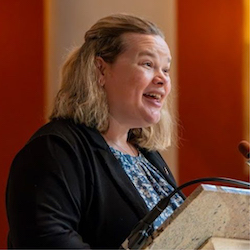
Rhonda Miska is a preacher, teacher, spiritual director, writer, and lay ecclesial minister. She serves as Communication Director at the Church of St. Timothy and is a member of St. Thomas More Catholic Community in the Archdiocese of St. Paul/Minneapolis. Rhonda is the founder and co-convener of the Catholic Women’s Preaching Circle, a peer community of Catholic women supporting and accompanying one another in breaking open God’s Word. She serves as the Lead Cohort Facilitator of PROCLAIM, a 22-month formation program for Catholic women in preaching and ministry of the Word.
Rhonda holds an MA from the Boston College School of Theology and Ministry and a certificate in spiritual direction. She is currently pursuing a Doctorate of Ministry in Preaching from the Aquinas Institute of Theology. She has served in parishes, universities, retreat centers, and as a Jesuit Volunteer (Nicaragua, 2002-2004). Her passion for preaching led her to discern vowed life with the Order of Preachers and she was in formation with Dominican Sisters from 2016-2020. Rhonda has served on the advisory board of Catholic Women Preach since its inception. She is active with Discerning Deacons, a movement to engage Catholics in discernment around the restoration of the diaconate to women.
Her writing has appeared in Catholic Women Speak: Bringing Our Gifts to the Table (Paulist Press, 2016), Pope Francis Lexicon (Collegeville, 2018), Catholic Women Preach: Raising Voices, Renewing the Church(2022), and Green Saints for a Green Generation (Orbis, 2024). She has also published in various print and online publications including America Magazine, U.S. Catholic, and Presence: A Journal of Catholic Poetry.
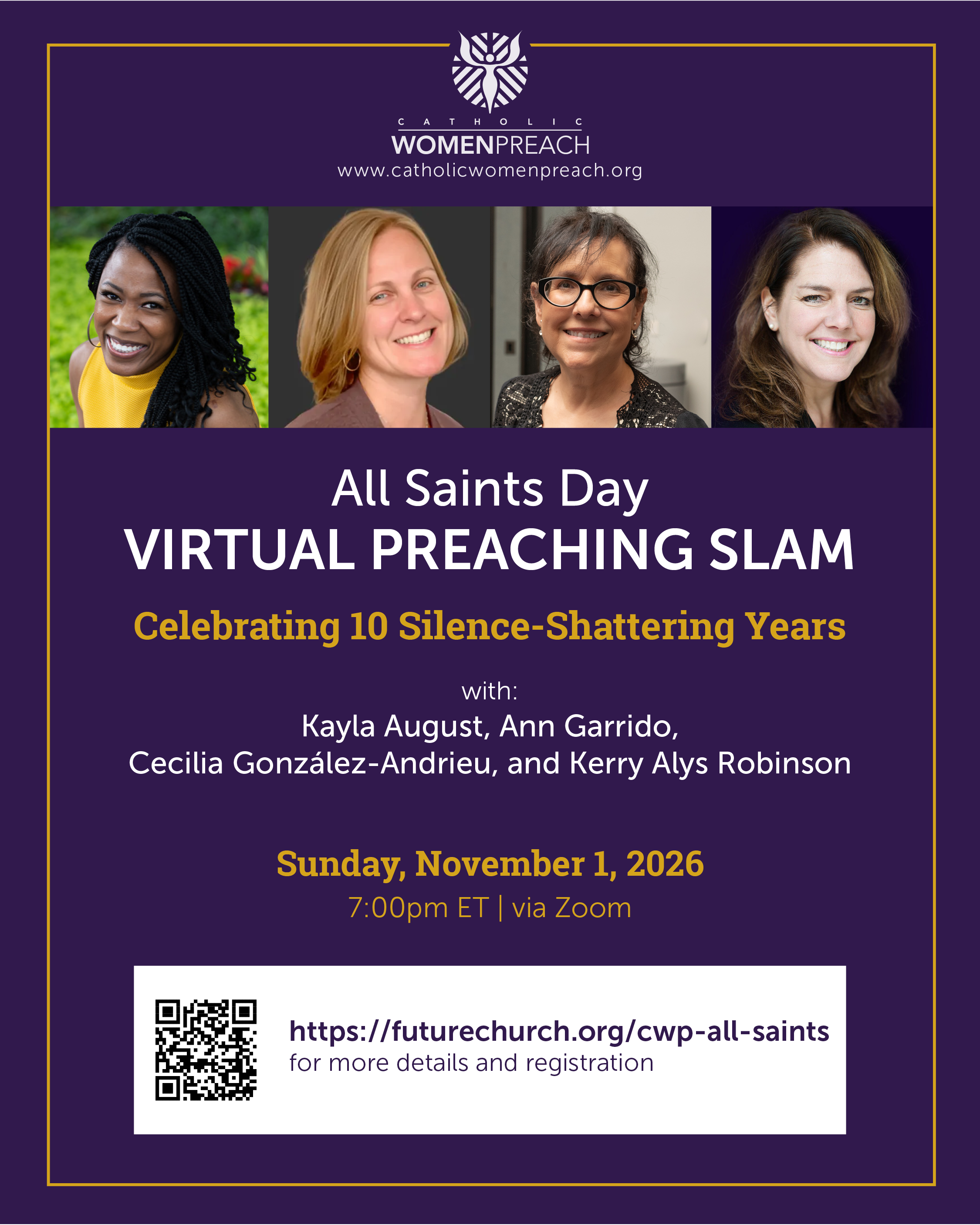
Sunday, November 1 at 7pm ET on Zoom: Join Catholic Women Preach, FutureChurch, and four extraordinary preachers as we celebrate the 10th Anniversary of Catholic Women Preach the best way we know how - by preaching!
We'll gather for a beautiful Liturgy of the Word with Kayla August, Ann Garrido, Cecilia González-Andrieu, and Kerry Alys Robinson who will break open the texts and uplift a woman saint of their choosing.
Ten years of raising voices and renewing the Church. Ten years of preaching that widens the table. Ten years of shattering the silence. Come celebrate with us!
Advertise with Catholic Women Preach: email Russ at russ@futurechurch.org
