

Angela
Angela
Howard McParland
Howard McParland
Even though we have fully passed through the season of Advent and Christmas and now sit squarely back into Ordinary Time, we still hear these themes of light emerging through shadows, of despair giving way to hope, in today’s readings from the prophet Isaiah and echoed in the Gospel.
I don’t know about you, but my perspective, 2025 was a doozy. I serve on the Justice Team of the Sisters of Mercy of the Americas, where we support our sisters, associates, and the entire Mercy community in advocacy efforts around our Critical Concerns of immigration, nonviolence, racism, women, and earth. And our work has been cut out for us this past year.
Despair often seemed to rule the day here in the United States, with militant ICE raids across the country, major setbacks in basic needs like SNAP benefits and health care, mass shootings, and global trauma rippling out from cuts in programs like USAID. We can certainly relate to being a people walking in darkness.
It does feel bleak, this time of year, with the holidays behind us and the cold and shadows stretching forth for at least a few more months here in New England. And this year, reeling from the upheavals of the last twelve months, feels especially heavy. Our country declared war on another in the first few days of 2026 and all signs point to continued targeting of migrants, LGBTQ+ siblings, and the poor. The despair resists the light.
While some of us with privilege might feel that we are living in unprecedented times, history teaches us that empires follow a predictable arc. Even Paul’s letter to the Corinthians reveals deep divisions in the early Christian community, where loyalties formed around the personalities of the apostles. “Was Paul crucified for you?” He reminds us. As Christians, our commitment to the God of liberation has to dictate our politics, and not the other way around.
And yet, of course, the story can’t and doesn’t end there. One of my Catholic heroes, Jesuit renegade Fr. Dan Berrigan, reflects:
“Indeed, the worst time, Isaiah dares imply, is the apt time. The Kairos of God, the epiphany of God’s hope, is exactly the time when our hands drop in helplessness, when all resources fail. This time, when little can be done, when the new gods own the time—this is exactly the time of the toppling of those unsteady thrones. If only we believed!”
These somber times call people of faith to resist—to resist the urge to drop our hands in helplessness, to resist the despair that threatens when cruelty seems to rule the day.
That feast of Epiphany we celebrated a few weeks ago reminds us of God’s ever-breaking-in to our world. An epiphany reveals something; it is an experience or a moment that takes us by surprise and changes everything. What reality is under the surface, unspoken or ignored? It is divine light breaking through, it is God’s Kairos redefining and reclaiming power from autocratic authorities to a dusty village manger.
We are living this kairotic moment now, too. Divine light breaks in through the people of faith whistling and showing up for detainees in Chicago, through religious sisters being omnipresent at protests for those without safety nets, through continued calls to Congress and accompaniment of those society leaves behind. Like the disciples who left their fishing nets to follow Jesus, people of faith all over our country are showing up, speaking out, and modeling nonviolent love of neighbor. Christmas teaches us about Emmanuel, God WITH us, in the struggle, in the mess. Epiphany sends us forth to live into that truth, so that, as Paul writes, “the cross of Christ might not be emptied of its meaning.”
In today’s Gospel, Jesus goes directly to the gloom in Galilee. And when he calls to Peter, Andrew, James, and John, they recognize the kairotic moment they are invited into and leave everything to show up. We cannot truly encounter Christ and remain unchanged. Epiphanies disrupt the status quo and invite us to do likewise.
Most of us are not in a position to leave our paying jobs, our own fishing nets and boats, but we can still respond to God’s Kairos. We can join movements and be part of a community supplying mutual aid to our neighbors. We can occupy the streets at organized, nonviolent protests and lobby our elected officials to prioritize those made poor. We can walk in the example of both the magi and the disciples to topple unsteady thrones of cruelty and injustice. We can listen for God’s call to us for what is ours to do in this moment and speak truth to power. After all, we stand on the shoulders of those who have done so for centuries now.
I want to close with the words of longtime peace activist, Elizabeth McAlister, who has walked the walk of the Gospel and continues to motivate and inspire with her example. She says:
“We are in a period of struggle with a movement spiritually deep and broadly connected – and a movement that knows it has to go deeper and broader yet. The good news is that we have not collapsed or imploded with despair! Many of us understand that a deeper resistance is summoned of us. We are trying, praying, working to be strategic, to be faithful, to be human. And we know that we must keep at it:
conspire the next steps
be in conversation
be in community
be in the streets
refuse to fight
disrupt business as usual
prefer poetry to ideology
pray for victims before nations.
The powers of death and destruction appear to reign. But they are undone. In short, dear friends: Be not awed by the mayhem with which the powers of this world would bamboozle us. When you light a candle let it mean intransigent resistance. When you pray, imagine a new world is possible. And then live it.”
Amen.
Angela Howard McParland
Angela Howard McParland

Angie McParland is a Kentucky native who has called New England home for most of her adult life. She has worked in ministry for more than twenty years across campus and parish settings in Nashville, Boston, and Rhode Island. From 2007 to 2016, she served as campus minister and Catholic chaplain to Brown University and Rhode Island School of Design in Providence and as Catholic chaplain at Bentley University in Waltham, MA from 2016 to 2020. Since 2021, she has been a member of the Justice Team of the Sisters of Mercy of the Americas, working on both state and federal issues of gun violence, immigration, poverty and economics, racism, and climate, among others. She is a co-founder of Nuns Against Gun Violence and a proud member of cohort 5 of Mercy Global's Emerging Leaders Fellowship.
She earned a B.A. in English and Religion from Centre College and a Master of Divinity at Vanderbilt Divinity School as well as a certificate in Religion, Gender, and Sexuality. She lives in Providence, RI with her three children: Oliver, Lorelai, and Eamon.
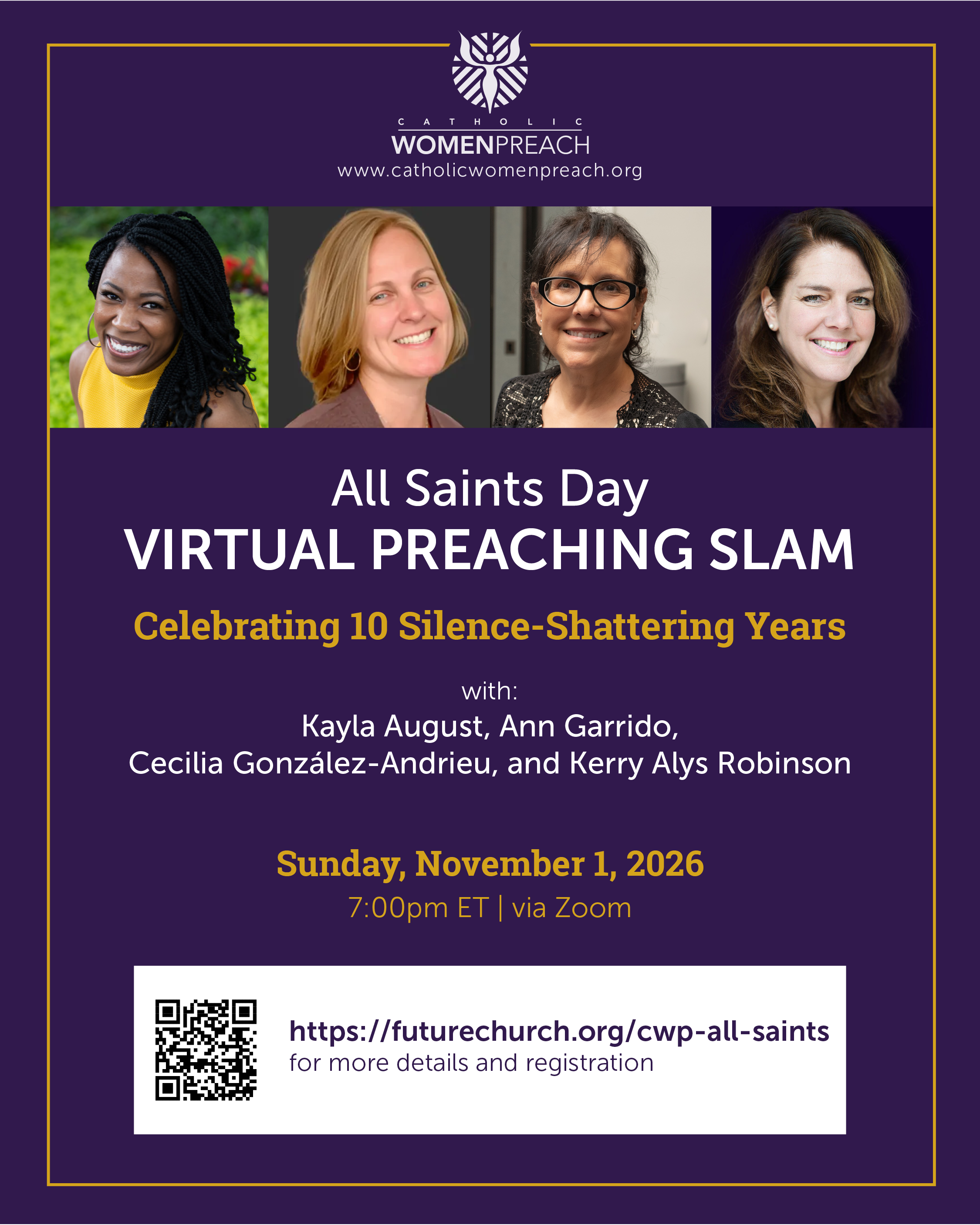
Sunday, November 1 at 7pm ET on Zoom: Join Catholic Women Preach, FutureChurch, and four extraordinary preachers as we celebrate the 10th Anniversary of Catholic Women Preach the best way we know how - by preaching!
We'll gather for a beautiful Liturgy of the Word with Kayla August, Ann Garrido, Cecilia González-Andrieu, and Kerry Alys Robinson who will break open the texts and uplift a woman saint of their choosing.
Ten years of raising voices and renewing the Church. Ten years of preaching that widens the table. Ten years of shattering the silence. Come celebrate with us!
Advertise with Catholic Women Preach: email Russ at russ@futurechurch.org
