

Joanna
Joanna
Arellano-Gonzalez
Arellano-Gonzalez
Let’s do some time traveling.
We’re back in first-century Palestine during Jesus’ lifetime. The land is under Roman occupation. Imperial Rome subjected poor Jewish farmers and peasants to a crushing reality. Wealth was concentrated among the powerful. Children and orphans were often sold into slavery. Those who were differently abled were pushed to the margins. And women were often considered the “poorest ofthe poor” because of how society and culture rendered them vulnerable and powerless.
You see, for women, they were either under the authority of their father or husband.
In many respects, women were considered property. They were treated and regarded as inferior to men, not as equal human beings.
And this is where Jesus changes all of that. Although he was raised within this culture, Jesus consistently challenged itsassumptions. Again and again, he radically restored the dignity of women through his words and his actions.
Jesus saw women differently because he saw them as God sees them.
Then comes the Resurrection.
Out of all his disciples, Jesus chose Mary Magdalene to be the first witness of the Resurrection and the one who would announce the Good News to the apostles.
Everything Jesus did was intentional. And his choice of Mary was intentional.
One of the reasons I appreciate the extracanonical Gospel of Mary is that it reveals how difficult this was for the early disciples to accept. In one part, after Mary shares spiritual teachings that Jesus revealed to her, Peter responds with disbelief: “Did he really speak secretly with a woman and not openly so that we could all hear? Are we just going to turn around and listen toher? Did he really choose her and prefer her to us? Surely, he wouldn't have wanted to show that she is more worthy than we are?”
Peter's words reflect the culture that shaped him. Even after walking with Jesus, hearing his teachings, and witnessing the way he honored women, Peter still struggled to let go of the assumptions he had inherited.
Mary begins to weep. Then Levi comes to her defense, saying, "Yet if the Saviour deemed her worthy…then who are you to despise and reject her?”
That question echoes across the centuries.
Who are we to reject whom Christ has made worthy?
That, for me, is the heart of today's feast day of Mary Magdalene.
Jesus affirmed, cultivated, and honored the spiritual leadership and wisdom of women. He recognized their God-given dignity in asociety that often denied it. Mary Magdalene's witness reminds us that God continually calls people to lead, proclaim, and bear witness in places where others may question their voice.
This feast day also invites us to look honestly at our own world.
Women who experience assault are still too often dismissed or not believed. Thousands of women remain trapped in humantrafficking. Many endure domestic violence behind closed doors. Around the world, rates of femicide continue to rise. Patriarchal systems still shape cultures and practices that diminish the dignity of women and limit their leadership.
As followers of Jesus, we are called to confront those realities because they stand in direct opposition to the Gospel. Honoring the dignity of women and recognizing their spiritual leadership is not a modern idea. It is literally the example Jesus himself gave to us.
So today I invite you to pray with Jesus and with Mary Magdalene.
To my fellow sisters, ask them to reveal the gifts God has placed within you and the courage to share them with the Church and the world. I’m so blessed to organize alongside women like Irma, Tiffany, Maricela, Sr. Jeremy, Sr. Cristin, Sue, Kascha, Pastor Sandra, Paloma, and so many others from CSPL who I see embodying this prayer everyday.
To my fellow brothers, ask them to reveal the ways our culture has shaped your assumptions about women. Ask for the grace to recognize and reject anything within you that diminishes the dignity of God's daughters. Ask for the humility to notice, encourage,and celebrate the women whose leadership already blesses your families, your parishes, and your communities, because there are many.
All throughout his ministry, Jesus challenged the traditions, attitudes, and practices that oppressed women.
Will we do the same?
And finally, remember the first Easter morning. Mary Magdalene announced the Resurrection, yet the apostles struggled to believe her.
May we never repeat that mistake.
To dismiss the witness and leadership of women is to ignore the example Jesus gave us. To disregard the messenger is to disregard the One who sent her.
May we have the courage to believe the witnesses God sends us, the humility to honor the gifts of women in our midst, and the faithto proclaim the Risen Christ as boldly as Mary Magdalene did.
Viajemos en el tiempo. Nos encontramos en la Palestina del siglo I, durante la vida de Jesús. La tierra estaba bajo el imperio romana. El Imperio Romano sometía a los pobres campesinos judíos a una realidad aplastante. La riqueza se concentraba en manos de los poderosos. Los niños y huérfanos a menudo eran vendidos como esclavos. Las personas con discapacidades eran marginadas. Y las mujeres eran consideradas las más pobres entre los pobres debido a la vulnerabilidad y la indefensión que la sociedad y la cultura les imponían.
Las mujeres estaban bajo la autoridad de su padre o su marido.
En muchos aspectos, las mujeres eran consideradas propiedad. Y fueron tratadas y consideradas inferiores a los hombres, no como seres humanos iguales.
Y aquí es donde Jesús cambia todo. Aunque se crió en esa cultura, Jesús desafió constantemente sus prejuicios. Una y otra vez,restauró radicalmente la dignidad de la mujer con sus palabras y sus acciones.
Jesús veía a las mujeres de manera diferente porque las veía como Dios las ve.
Y Luego llega la Resurrección.
De entre todos sus discípulos, Jesús eligió a María Magdalena para ser la primera testigo de la Resurrección y quien anunciaría la Buena Nueva a los apóstoles.
Todo lo que Jesús hizo fue intencional. Y su elección de María también lo fue.
Una de las razones por las que aprecio el Evangelio extracanónico de María es que revela lo difícil que fue para los primeros discípulos aceptar esto. En una parte, después de que María comparte algunas enseñanzas espirituales que Jesús le reveló, Pedro responde bien enojado: «¿De verdad habló en secreto con una mujer y no abiertamente para que todos pudiéramos oír? ¿Acasoíbamos a simplemente darle la espalda y escucharla? ¿De verdad la eligió y la prefirió a nosotros? Seguramente no habría querido demostrar que ella es más valiosa que nosotros».
Las palabras de Pedro reflejan la cultura que lo formó. Incluso después de caminar con Jesús, escuchar sus enseñanzas y presenciarcómo honraba a las mujeres, Pedro aún luchaba por desprenderse de los prejuicios que había heredado.
María comienza a llorar. Entonces Leví sale en su defensa, diciendo: «Pero si el Salvador la consideró digna… ¿quiénes somos nosotros para despreciarla y rechazarla?».
Esa pregunta resuena a través de los siglos.
¿Quiénes somos nosotros para rechazar a quien Cristo ha hecho digno? Ese, para mí, es el corazón de la fiesta de María Magdalena de hoy.
Jesús afirmó, cultivó y honró el liderazgo espiritual y la sabiduría de las mujeres. Reconoció su dignidad, un don de Dios, en unasociedad que a menudo la negaba. El testimonio de María Magdalena nos recuerda que Dios llama continuamente a las personas a liderar, proclamar y dar testimonio en lugares donde otros podrían cuestionar su voz.
Esta fiesta también nos invita a mirar con honestidad nuestro propio mundo.
Las mujeres que sufren asaltos aún son ignoradas o no se les cree con demasiada frecuencia. Miles de mujeres siguen atrapadas en latrata de personas. Muchas sufren violencia doméstica a puerta cerrada. En todo el mundo, las tasas de feminicidio siguen aumentando. Los sistemas patriarcales aún dan forma a culturas y sistemas que disminuyen la dignidad de las mujeres y limitan su liderazgo.
Como seguidoras de Jesús, estamos llamadas a confrontar estas realidades porque se oponen directamente al Evangelio. Honrar ladignidad de las mujeres y reconocer su liderazgo espiritual no es una idea moderna. Es, literalmente, el ejemplo que Jesús mismo nos dio.
Así que hoy las invito a orar con Jesús y con María Magdalena.
A mis hermanas: pidan que se revelen los dones que Dios ha puesto en ustedes y que reciban la valentía para compartirlos con la Iglesia y el mundo. Me siento muy bendecida de organizar y trabajar junto a mujeres como Irma, Tiffany, Maricela, las hermanasJeremy y Cristin, Sue, Kascha, la pastora Sandra, Paloma y tantas otras de CSPL, en quienes veo cómo hacen realidad esta oración cada día.
A mis hermanos: pidan que se revelen las formas en que nuestra cultura ha moldeado sus ideas preconcebidas sobre las mujeres.Pidan la gracia de reconocer y rechazar todo aquello en su interior que menoscabe la dignidad de las hijas de Dios. Pidan la humildad para notar, alentar y celebrar a las mujeres cuyo liderazgo ya bendice a sus familias, parroquias y comunidades, pues son muchas.
A lo largo de su ministerio, Jesús desafió las tradiciones, actitudes y prácticas que oprimían a las mujeres.
¿Haremos nosotros lo mismo?
Y, por último, recordemos aquella primera mañana de Pascua. María Magdalena anunció la Resurrección, pero a los apóstoles les costó creerle.
Que nunca repitamos ese error.
Desestimar el testimonio y el liderazgo de las mujeres es ignorar el ejemplo que Jesús nos dio. Rechazar a la mensajera es rechazar a Aquel que la envió.
Que tengamos la valentía de creer a los testigos que Dios nos envía, la humildad de honrar los dones de las mujeres que nos rodean y la fe para proclamar a Cristo Resucitado con la misma valentía que lo hizo María Magdalena.
Joanna Arellano-Gonzalez
Joanna Arellano-Gonzalez

Joanna Arellano-Gonzalez is a proud first-generation Mexican-American from the La Villita neighborhood on Chicago’s South Side. She is a co-founder and Director of Training and Formation at the Coalition for Spiritual and Public Leadership (CSPL), a Catholic and Christian-rooted community organizing coalition that advances community transformation through spirituality and grassroots organizing. She holds a Master of Arts in Christian Spirituality from Fordham University, with a concentration in Spiritual Direction.
A writer, speaker, and formator, Joanna explores the intersections of spirituality, theology, organizing, and the historical Jesus. Her essays, reflections, and articles have appeared in a variety of Catholic and social justice publications, including Give Us This Day and the Center for Action and Contemplation. She has also served as a guest preacher with Catholic Women Preach. She is currently writing a series on the historical Jesus.
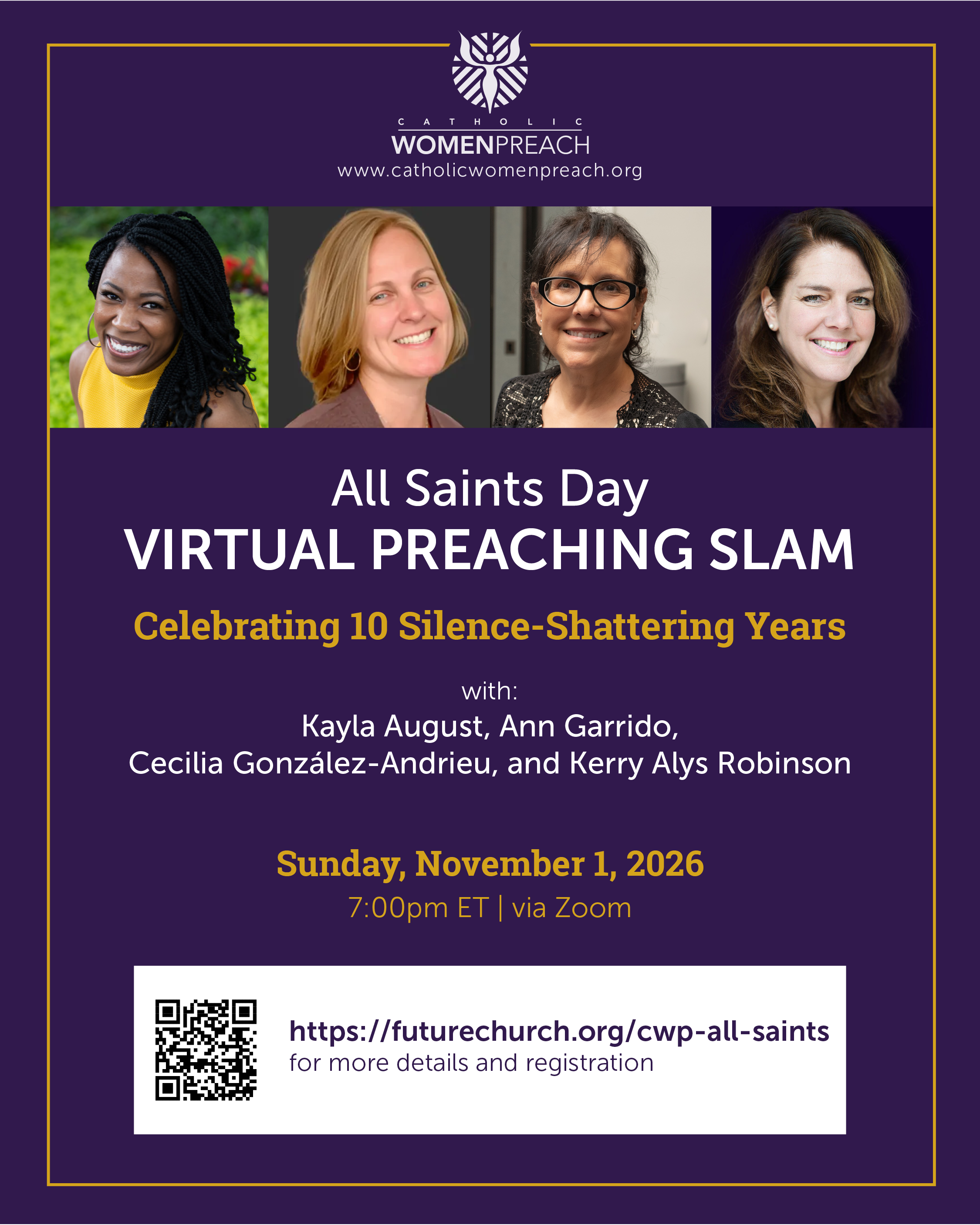
Sunday, November 1 at 7pm ET on Zoom: Join Catholic Women Preach, FutureChurch, and four extraordinary preachers as we celebrate the 10th Anniversary of Catholic Women Preach the best way we know how - by preaching!
We'll gather for a beautiful Liturgy of the Word with Kayla August, Ann Garrido, Cecilia González-Andrieu, and Kerry Alys Robinson who will break open the texts and uplift a woman saint of their choosing.
Ten years of raising voices and renewing the Church. Ten years of preaching that widens the table. Ten years of shattering the silence. Come celebrate with us!
Advertise with Catholic Women Preach: email Russ at russ@futurechurch.org
